Roughly 1 in 6 Americans live with daith piercing for migraines, and many are flat-out exhausted by pills that barely touch the pain. While interest in this migraine piercing is skyrocketing, the internet remains a battlefield, doctors often say no, but thousands of real-world users scream yes.
At daithpiercing.io, we are cutting through the noise. We break down the actual evidence from the vagus nerve theory to the role of the placebo effect and its roots in acupuncture. No fluff, no hype just a clear decision checklist to help you find an alternative medicine path that actually works.
What Is a Daith Piercing?
Before diving into the medical debate, it is essential to understand the anatomy. A daith piercing (correctly pronounced doth) is located at the crus of the helix, the innermost cartilage fold situated directly above the ear canal. Because of its location in dense, tough tissue, it is typically performed with a 14g or 16g hollow needle.
Daith Piercing at a Glance
| Feature | Details |
| Pronunciation | Doth (rhymes with moth) |
| Anatomical Location | Crus of the helix (innermost cartilage fold) |
| Standard Gauge | 14g to 16g |
| Common Jewelry | Clickers, seamless rings, or curved barbells |
| Healing Time | 6–9 months |
Quick Definition: A daith piercing is a cartilage piercing through the innermost fold of the outer ear (crus of the helix), located right above the ear canal. It takes 6–9 months to heal fully.
While it is a staple in the world of aesthetics, its placement is precisely why many believe it holds the key to silencing chronic migraine pain.
Daith Piercing for Migraines: Does It Actually Work?
Does a daith piercing actually help headaches? The short answer: Science says no, but thousands of patients say yes. While there is no clinical proof, anecdotal relief is overwhelmingly high.
Medical authorities, including the American Migraine Foundation and the Cleveland Clinic, maintain that no formal scientific evidence confirms its efficacy. This stance is backed by the 2024 Pradhan review, which highlights the lack of randomized clinical trials.
However, real-world daith piercing migraine success stories tell a different story. Data from the London Migraine Clinic (1,262 patients) showed that 37% reported their migraines stopped entirely, while 30% saw them drop to one day or less per month.
Another survey by MigrainePal found that 64% of respondents experienced a reduction in pain, with nearly 20% entering full remission. Ultimately, a daith piercing for migraines remains a wildcard, not a guaranteed cure, but a potential game-changer for many.
The Science Behind Daith Piercing Headache Relief
While many dismiss it as a trend, there is a fascinating neurological hypothesis that suggests this piercing might do more than just look good.
The Vagus Nerve Theory
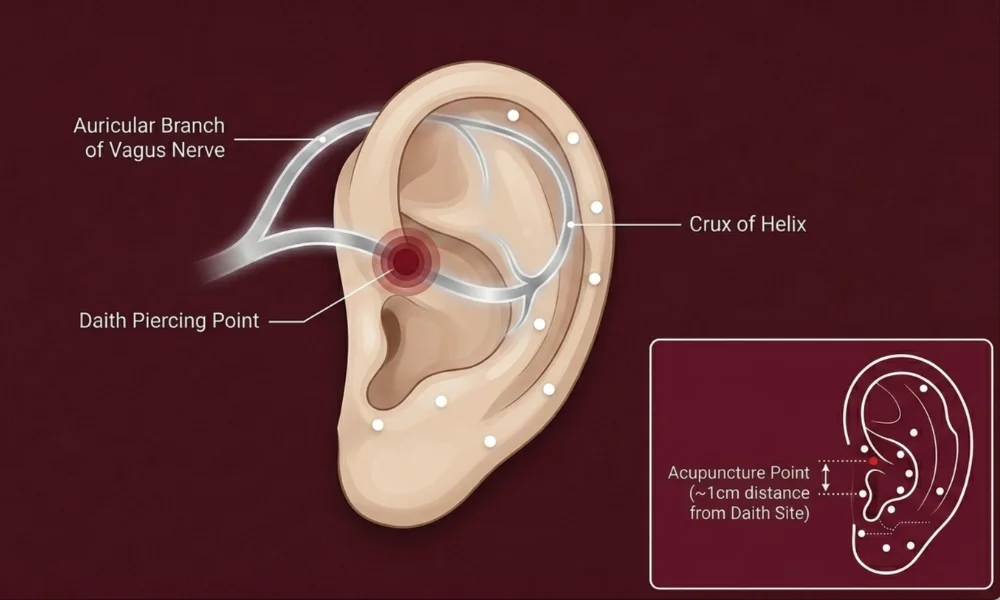
The most compelling argument for daith piercing headache relief lies in the vagus nerve. This nerve travels from your brainstem to your abdomen, but a specific “auricular branch” passes directly through the ear’s inner cartilage.
The theory is simple, constant micro-pressure from the jewelry may trigger vagus nerve stimulation. This potentially blocks pain signals in the brain’s migraine center. A 2017 Cascio Rizzo case study (PubMed PMC5711775) famously documented a 54-year-old patient who saw a dramatic drop in migraine frequency after getting pierced.
The Acupuncture Connection
Many link the procedure to the daith piercing acupuncture point. Traditional Chinese Medicine maps this specific ear fold to pain-relief and digestive zones. While acupuncture has strong clinical backing for migraines, there is a catch: a standard piercing is often about 1 cm off from the exact pressure point. It is close, but not a medical bullseye.
What the Latest Research Says (2024–2026)
The 2024 Pradhan narrative review in the Headache journal is the most current data available. After reviewing global databases, researchers reached two key conclusions:
-
The Verdict: Current evidence does not support daith piercing as a proven clinical treatment for chronic pain.
-
The Silver Lining: Scientists acknowledged the vagal mechanism is biologically plausible and deserves further formal study.
Research Summary: As of 2026, no randomized clinical trial confirms daith piercing for migraine relief. While the 2024 Pradhan review calls the theory plausible, the evidence remains insufficient for a medical green light.
Real Daith Piercing for Migraines Success Stories
While researchers wait for more data, thousands of individuals have already taken the leap. Many daith piercing migraine success stories follow a striking pattern: users report their migraines dropping from four times a week to just once a month. According to data from the London Migraine Clinic, 60% of long-term piercees report that their relief sustained well past the 12-month mark.
However, honesty is key. Roughly 15–20% of users report no change at all, and a small margin deal with frustrating infections. The most successful cases often involve a dual approach, where the piercing is combined with disciplined lifestyle changes like improved sleep and hydration.
In a survey of 1,107 daith piercing recipients, 64% reported a reduction in migraine frequency, with 18–20% achieving full remission from their chronic pain.
Can Daith Piercing Help Anxiety, Tension Headache and Vestibular Migraine?
While migraines are the primary driver for this procedure, many are now exploring its impact on other neurological conditions. This is a significant content gap, as the overlap between these conditions and the vagus nerve is scientifically intriguing.
Daith Piercing Anxiety Relief
Can a daith piercing anxiety connection exist? The theory suggests that because vagus nerve stimulation is linked to parasympathetic (rest and digest) activation, the piercing may help lower a person’s baseline stress. Some users report a calmer mood and fewer panic episodes, mirroring the effects of medical-grade vagal therapies.
Daith Piercing for Tension Headache and Vestibular Migraine
For tension headache and vestibular migraine (the type characterized by dizziness), evidence is even scarcer. While interest is growing in the vestibular community, there are currently no studies and only a handful of anecdotal reports. Most experts suggest sticking to proven treatments for these specific subtypes.
Which Ear Should You Pierce for Migraine Relief?
The general consensus among the migraine community and professional piercers is to pierce the ear on the side where your migraine pain is strongest.
For those who suffer from bilateral migraines (pain on both sides), some choose to pierce both ears. However, keep in mind that double piercing significantly increases your infection risk and doubles the 6–9 month healing time, as you would not have a good side to sleep on.
Daith vs Tragus vs Rook Piercing for Migraines
While the daith is the most famous migraine piercing, other ear placements are often discussed. Here is how they compare:
| Piercing Type | Location | Migraine Claim Strength | Healing Time | Pain Scale (1–10) |
| Daith | Inner cartilage fold | Strongest anecdotal | 6–9 months | 6–7 |
| Tragus | Front cartilage flap | Moderate anecdotal | 3–6 months | 5–6 |
| Rook | Upper inner ridge | Weak | 6–12 months | 6–7 |
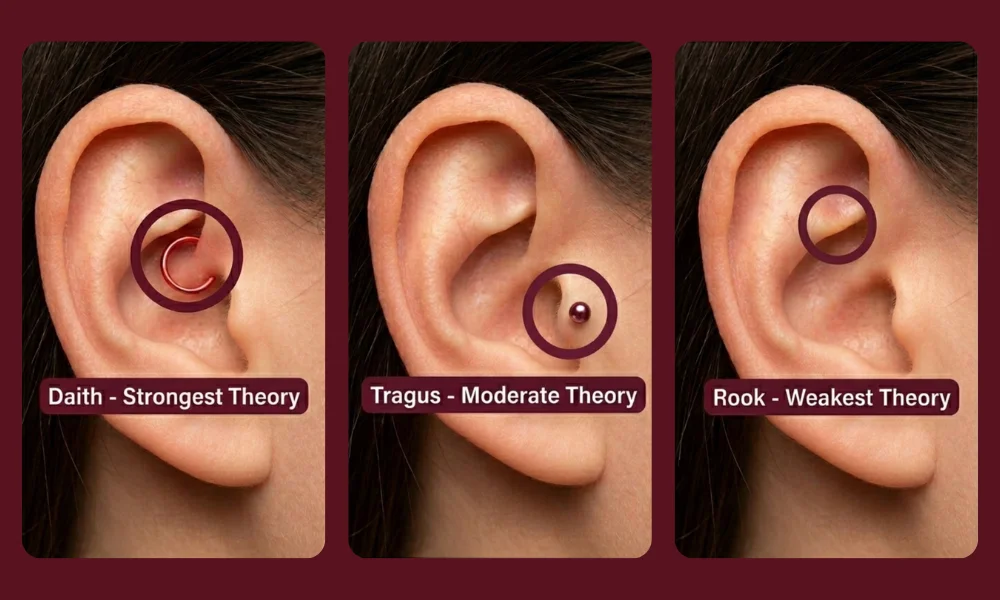
The Verdict: We recommend the daith as it remains the most-studied and most-reported option. While the tragus and rook are near vagus nerve branches, they lack the same volume of success stories.
Cost, Pain and What to Expect
Before committing to a daith piercing for migraines, it is vital to understand the logistics. In the USA, you can expect to pay between $60 and $180 total ($40–$100 for the procedure, plus $20–$80 for jewelry).
In terms of sensation, most people rate the pain as a 6 or 7 out of 10. It feels like a sharp, intense pinch lasting about 6–9 seconds. While the procedure itself takes under five minutes, the commitment is long-term, initial soreness fades in 2–4 weeks, but full cartilage healing takes 6–9 months. For a deeper dive into the sensation, check out our full daith piercing pain guide.
Risks and Side Effects of Daith Piercing for Migraines
While the success stories are tempting, you must weigh them against the risks. Cartilage piercings are more prone to complications than earlobes. Common side effects include:
- Infection: High risk of cellulitis if aftercare is neglected.
- Keloids & Scarring: Permanent bumps can form at the entry or exit site.
- Allergic Dermatitis: Often caused by nickel in low-quality jewelry.
- Rejection: The body may slowly push the metal out of the skin.
To minimize these risks, always opt for implant-grade titanium or 14k gold jewelry, which significantly reduces the chance of an adverse reaction.
Should You Get a Daith Piercing for Migraines? Decision Checklist
If you are still on the fence, use this quick checklist to see if you are a good candidate for this procedure. While it is not a medical fix, it can be a strategic addition to your pain management toolkit if you meet the right criteria.
- You have tried 2+ migraine treatments without full relief.
- You are open to a non-medical, anecdotal approach.
- You can commit to 6–9 months of diligent aftercare.
- You have no nickel allergies or bleeding disorders.
- You have access to a licensed, high-quality professional piercer.
The Verdict: If you checked 4 or more boxes, a daith piercing is a reasonable wildcard to explore. Just remember to manage your expectations think of it as a potential supplement to your relief, not a guaranteed replacement for your doctor’s advice.
Better-Evidence Alternatives of Daith Piercing for Migraines
If you are not ready for a 9–month healing commitment, several alternative medicine options and clinical treatments offer stronger evidence for migraine treatment than a piercing:
- Acupuncture: Boasts more robust clinical data for chronic pain than permanent piercings.
- CGRP Inhibitors: Modern medications like Aimovig or Emgality specifically target migraine pathways.
- Supplements: High-dose Magnesium and Riboflavin (B2) are often doctor-recommended.
- CBT: Cognitive Behavioral Therapy helps manage the psychological load of chronic pain.
- Lifestyle Fundamentals: Strict sleep hygiene, consistent hydration, and digital trigger logging remain the gold standard for a long-term headache cure.
Conclusion
The honest verdict on daith piercing for migraines is simple, while it is not a clinically proven cure, it isn’t a myth either. The biological link to the vagus nerve is plausible, and the thousands of success stories are too significant to ignore. However, the risks from infection to a lengthy healing process require a serious commitment.
At daithpiercing.io, we believe in giving you the full picture rather than overselling a trend. If you decide to move forward, treat the piercing as a wildcard addition to your existing medical care, not a replacement for it. Before you book your appointment, be sure to check out our full aftercare guide and our pain scale breakdown to ensure you are fully prepared for the journey ahead.
Frequently Asked Questions
Does a daith piercing actually help migraines?
There is no clinical proof, but it offers significant anecdotal relief. Surveys show up to 64% of users report fewer headaches. While medical bodies remain skeptical, thousands of success stories suggest a daith piercing for migraines is a viable wildcard for those who haven’t found relief through traditional medicine.
Which side of the ear should I get pierced for migraines?
You should pierce the ear on the side where your migraine pain is most intense or frequent. If you experience pain on both sides, it is still best to choose one side first to ensure easier side-sleeping and a smoother 6–9 month healing process.
How long until I see migraine relief after a daith piercing?
Some report instant relief, while others notice a change after the initial 2–4 weeks of soreness. Because the theory relies on constant pressure, the most consistent results usually appear once the primary swelling subsides and the jewelry settles against the cartilage.
Can a daith piercing help with anxiety or vestibular migraine?
Potentially, but evidence is purely anecdotal. The connection to the vagus nerve suggests a possible calming effect for anxiety, and some users with vestibular issues report fewer dizzy spells. However, no formal studies currently confirm these specific benefits.
Is the daith piercing migraine theory just a placebo effect?
It is likely a combination. While the power of belief plays a role in any daith piercing for migraines, the proximity to the vagus nerve offers a plausible biological explanation. Whether the relief from a daith piercing for migraines is neurological or a placebo, the reduction in pain remains a real benefit for the wearer.