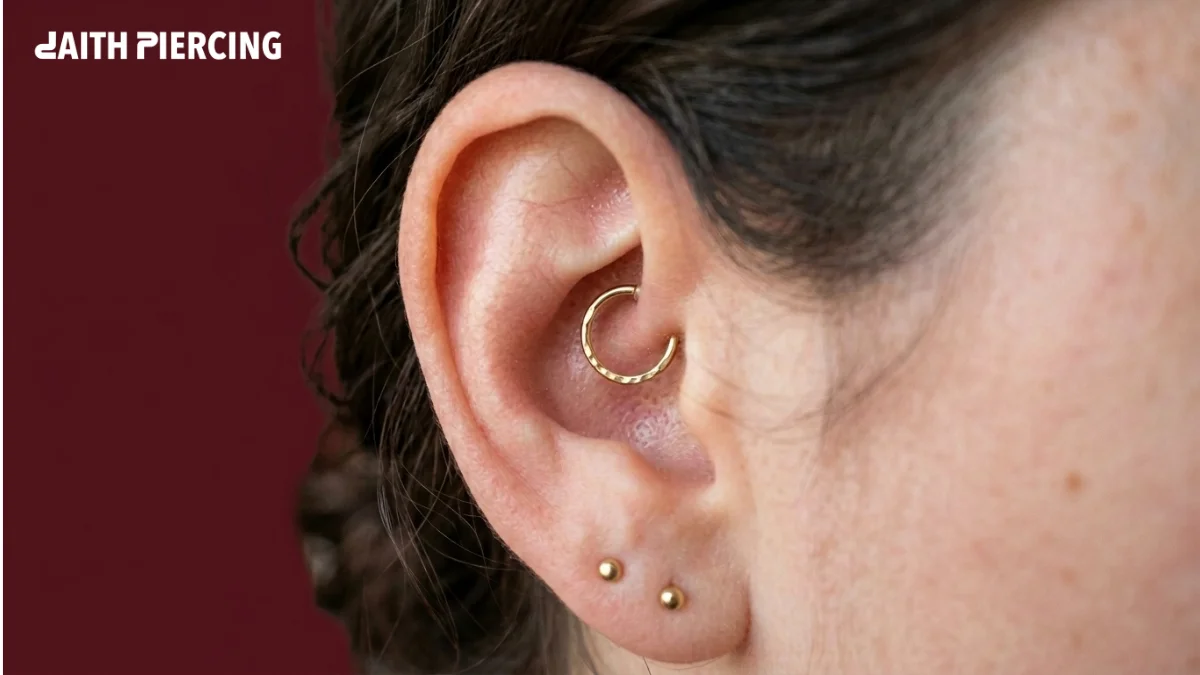
A daith piercing for migraines often seems like a good last resort for people who are tired of taking medicine and sitting in dark rooms. This piercing, which goes through the innermost fold of cartilage in the ear, is becoming more popular as an alternative to Botox or prescription drugs for people who want to feel better.
We put facts ahead of viral claims at daithpiercing.io. Many people in the community say that daith migraines help, but clinical evidence in 2026 is still mixed. This guide looks at the link between the daith acupuncture point and pain relief. It helps you decide if this treatment is right for you based on the most recent information and safety concerns.
What Is a Daith Piercing? (Basics of the Migraine Piercing)
The daith piercing can be found on the crus of the helix, which is the smallest fold of cartilage that lies right next to the ear canal. The daith piercing is clearly different from a regular helix or tragus piercing due to its location near an acupuncture point of daith which is why this procedure has become popular as a remedy for migraines.
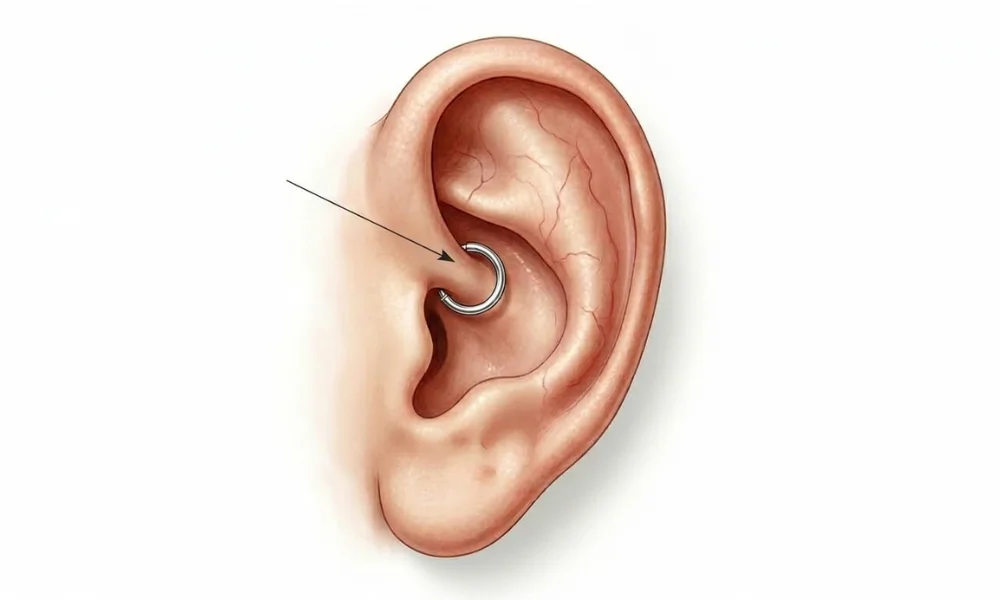
Piercers normally use either a 16g or 14g needle for such procedures with the jewelry choices being seamless ring, clicker, or curved barbell. There has been a tremendous increase in the number of people opting for a daith piercing for migraines in various piercing studios around the US.
The Daith Piercing Migraines Theory: How Is It Supposed to Work?
It may seem like pure magic that a small piece of jewelry could prevent an occurrence such as a migraine; however, this notion is scientifically based. It revolves around the way that pain information is transmitted through our nervous system.
The Theory of Vagal Modulation Explained (For Dummies)
One of the strongest arguments behind the effectiveness of the daith piercing for migraines is the role played by the vagus nerve. One of its smaller branches extends itself through the inner part of the cartilage found in the ear.
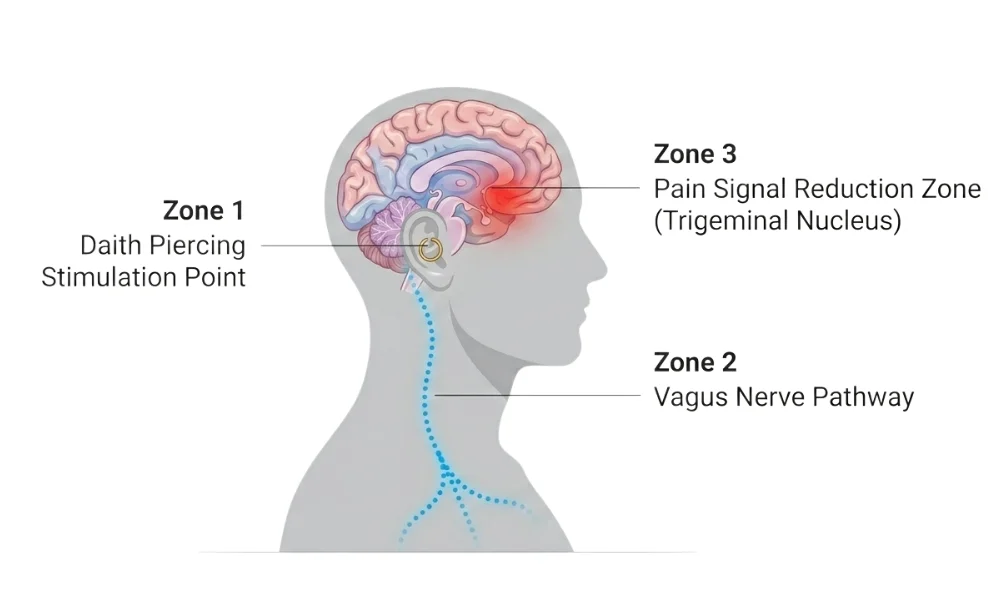
By piercing the daith, the jewelry used puts pressure on the nerve fiber located in this particular area of the body. By doing so, vagal afferents are stimulated; they send information to the brain that could act as a dimmer switch reducing the sensation of a migraine attack. The theory is very much akin to the FDA-approved treatment called vagal nerve stimulation (VNS).
Acupuncture and the Significance of Daith Piercing
Traditional healing practices provide a different angle on the matter. Auricular acupuncture has identified specific acupuncture points within the daith area for many years, associating this region with therapeutic benefits in relieving pain and aiding the digestive tract.
Nevertheless, there is one important detail that is frequently overlooked in discussions regarding the effects of daith piercing on migraines: specificity. Traditional acupuncture involves locating a point with high precision, whereas a piercing is a more permanent procedure involving piercing of the skin.
Besides, the precise location of the daith acupuncture point for migraines is situated around 1 centimeter away from where an ordinary piercing would be positioned.
The Reality of the Placebo Effect in Migraine Piercings
It is important to talk about what is known as the placebo effect when we talk about daith piercings for migraine treatment. It is known that in migraine studies, the placebo effect is exceptionally high, and can be around 30-40%.
Since a daith piercing is a physical procedure which causes minor pain, one’s brain may experience the release of dopamine and endorphins, causing what can be called a honeymoon phase where pain diminishes.
The effects last from several weeks to months after which many people notice a reduction in their migraine relief from the daith piercing.
Why the Relief Often Feels Real But Temporary
-
The Novelty Factor: A new intervention often triggers a psychological shift in how we perceive pain.
-
Expectation Bias: If you believe the daith acupuncture point will work, your nervous system may temporarily dampen pain signals.
-
Regression to the Mean: People often get pierced when their migraines are at their absolute worst; when the flare naturally subsides, the piercing gets the credit.
While this doesn’t mean the relief isn’t real to the person experiencing it, it explains why the medical community is hesitant to label it a permanent cure.
Personal Factors: Who Sees the Best Results?
Based on available data and community reports, results from a daith piercing for migraines are highly individualized. There is no standard outcome, but certain factors seem to influence whether someone experiences daith migraine relief:
-
Migraine Type: Those with vestibular migraines or tension-type headaches often report different success rates than those with classic aura migraines.
-
Side of the Head: Many users choose to pierce the ear on the side where their headaches are most frequent or intense.
-
Anatomy: The effectiveness may depend on whether the piercer successfully targets the area near the vagus nerve branch.
If you are considering this for migraine piercing evidence, it is essential to track your headache frequency before and after the procedure to see if the change is statistically significant for your specific case.
Which Ear Should You Pierce for Migraine Relief? Left, Right, or Both?
If you’ve decided to get a daith piercing to help with migraines, the next question is where to put it. There are no official clinical guidelines, so whether you choose the left, right, or both ears depends a lot on your own pain patterns and migraine piercing evidence from existing case studies.
Picking the Side of the Pain
People who get migraines often pierce their ears on the side where the pain is most common or severe. If your migraines only affect one side of your head, the usual way to try to change the neural pathways on that side is to target that side.
Why You Should Get Bilateral Piercings
Some people who have bilateral migraines, which means that the pain spreads across both sides, choose to get piercings in both ears.
Real-World Data: A significant case study published in Frontiers in Neurology (indexed in PMC) reported a patient with refractory chronic migraines who experienced substantial improvement solely after undergoing bilateral daith piercings.
The Trade-off: Getting both ears done may give you better daith migraine relief in theory, but it will take twice as long to heal and make you more likely to get an infection. It can also be hard to sleep because you can’t comfortably lie on either side for the first few months.
Decision Framework
Before choosing a side, track your attacks for 30 days. If a clear pattern emerges, use that data to guide your placement. We recommend discussing this with both your piercer and your neurologist. A piercer understands the anatomy of the daith acupuncture point, while a neurologist can help you determine if your specific migraine type is likely to respond to vagal modulation.
Daith Piercing Migraines vs Other Alternative Treatments
When exploring daith migraine relief, it is helpful to see how this piercing compares to other medical and alternative interventions. While a daith piercing for migraines is often the most accessible and affordable option, it sits at the bottom of the list regarding clinical validation.
The following table compares the daith piercing migraines theory against established medical treatments and other nerve-stimulation technologies.
| Treatment | Mechanism | Evidence Level | Cost / Commitment |
| Daith Piercing | Potential vagus nerve stimulation via daith acupuncture point. | Anecdotal / Low | One-time cost ($50–$100); permanent. |
| Tragus Piercing | Similar theory to daith; targets a different cartilage fold. | Very Low | One-time cost; permanent. |
| Auriculotherapy | Non-invasive ear acupuncture or seeds. | Moderate (Clinical) | Recurring sessions; non-permanent. |
| Cefaly Device | External trigeminal nerve stimulator (eTNS). | High (FDA-Cleared) | Upfront device cost; reusable. |
| GammaCore | Non-invasive vagus nerve stimulator (nVNS). | High (FDA-Cleared) | Prescription required; recurring cost. |
| Botox | Preventive injections for chronic migraine. | Very High (FDA-Approved) | Requires injections every 12 weeks. |
| CGRP Inhibitors | Monthly injections targeting specific proteins. | Very High (FDA-Approved) | Prescription; high-cost/insurance-heavy. |
Key Takeaway
The daith piercing for migraines is a low-cost, one-time wildcard compared to expensive medical treatments like Botox. However, with migraine piercing evidence being largely anecdotal, it is not a substitute for FDA-approved care. Many choose it as a supplemental tactic alongside their primary treatment plan.
Daith Piercing Migraines: Risks and Complications
Although daith piercing for migraines might sound very tempting, it’s important to remember that the medical risks involved in this type of piercing are quite high. Since cartilage tissue lacks a good blood supply, it takes about 6 to 12 months to heal.
Infections: One-third of all people getting daith piercings have problems, ranging from local “bumps” to severe infections such as cellulitis.
Allergies: Inadequate jewelry may lead to contact dermatitis, only choose titanium to prevent allergic reactions.
Migraine Attack Trigger: Pain of daith piercing may trigger an immediate attack.
Medical Contraindications: Ask your physician first if you have any immune system-related disorders or take blood thinners.
Is daith piercing for migraines safe? Yes, as long as you get pierced in a sterile environment and care properly for your new piercing. Nevertheless, risks are much higher compared to conventional earlobe piercings.
Daith Piercing Migraines Aftercare: Quick Healing Guide
A daith piercing for migraines takes 6 to 12 months to heal fully. Proper aftercare is vital to prevent infection and ensure you actually experience any potential daith migraine relief.
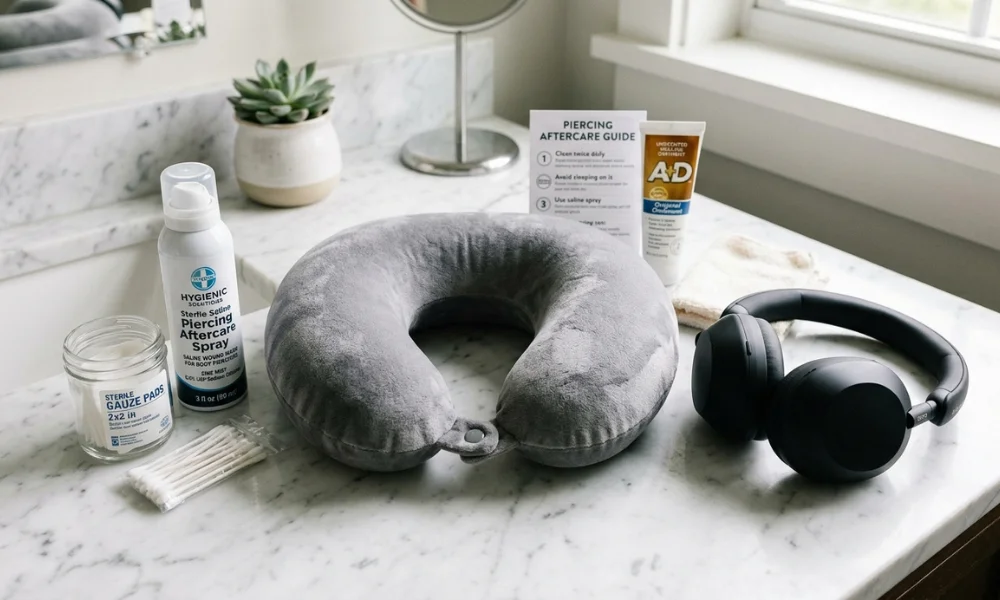
The Daily Routine
-
Clean: Spray the area twice daily with sterile saline.
-
Avoid: Do not use rubbing alcohol or hydrogen peroxide; they damage healing tissue.
-
Hands Off: Never touch or rotate the jewelry with unwashed hands.
Critical Don’ts
-
No Pressure: Use a travel pillow to avoid sleeping on the piercing.
-
No Earbuds: Switch to over-ear headphones for at least 3–4 months.
-
No Swimming: Avoid pools or lakes for 8–12 weeks to prevent bacterial infection.
When to See a Doctor
If you experience extreme swelling, heat, or yellow discharge, seek medical help. Do not remove the jewelry yourself, as it can trap infection. For more details, visit our aftercare guide at daithpiercing
Should You Get a Daith Piercing for Migraines?
Deciding to get a daith piercing for migraines is a personal choice that should be made after weighing the anecdotal benefits against the known medical risks. This framework helps you move past the hype and evaluate if this procedure aligns with your current pain management strategy.
The Decision Matrix
| Consider Getting a Daith Piercing If: | Think Carefully Before Getting a Daith Piercing If: |
| You have tried multiple medications without adequate relief. | Your migraines are easily triggered by physical pain or acute stress. |
| You are looking for a low-cost, exploratory alternative. | you have a medical history of slow healing or keloid scarring. |
| You understand that daith migraine relief is not clinically guaranteed. | You expect a total cure rather than a potential reduction in symptoms. |
| You have already consulted your neurologist about vagal modulation. | You haven’t yet tried evidence-backed options like CGRP inhibitors or Cefaly. |
| You are not on blood thinners or immunosuppressants. | You are uncomfortable with the 6–12 month healing commitment. |
Conclusion: The Real Story on Daith Piercing and Migraines
Despite the lack of scientific consensus on the link between daith piercing and migraines, there are many success stories from within the migraine community. Whether it provides life-changing daith migraine relief or simply makes for a fashionable pierce, this procedure should not be overlooked in the migraine community.
If you make the decision to go through with daith piercing, then take steps to stay safe and healthy. Get approval from your doctor, work with a professional, and follow proper aftercare protocol. This process is not a guarantee of pain relief but can certainly serve as a relatively cheap wildcard. Be sure to check out the entire collection at daithpiercing
Frequently Asked Questions
Does a daith piercing actually help with migraines?
There is no clinical proof that it’s a medical cure. While many report daith migraine relief through potential vagus nerve stimulation, the medical community currently views these results as anecdotal or a placebo effect.
Which ear should I pierce for migraine relief?
Common practice is to pierce the side where your pain is most frequent or intense. For bilateral migraines, some people pierce both ears, though this doubles the healing time and infection risk.
How long does it take to see results?
Some report immediate relief, but this may be a temporary endorphin surge. Because cartilage takes 6 to 12 months to heal, long-term effectiveness can only be accurately judged after the area has fully recovered.
Is getting a daith piercing for migraines safe?
It is generally safe if done by a licensed professional using sterile equipment. However, complications like piercing bumps or infections occur in about one-third of cases due to the limited blood flow in ear cartilage.