The studio door is closed behind you, and you find yourself asking yourself the following question when will I finally be able to sleep on this side again? The daith piercing healing time is famous for its somewhat bumpy ride. Although most online resources will offer you a rather indefinite period of three months, the daith healing process itself is entirely individual.
As the daith piercing takes place right in the densest section of the ear’s cartilage, its healing process may come out unpredictable. With this guide to the daith piercing healing stages, you will know how to approach it in a rather hassle-free manner.
How Long Does Daith Piercing Healing Time Actually Take?
Let’s face it; if you’re seeking instant gratification, the daith is not your best bet. Where lobes will heal in just weeks, the daith piercing healing time usually lasts from 6 to 12 months or even up to 18 months.
But why? Biology. The daith is located in thick, avascular cartilage that gets little blood supply, which makes your body work hard to heal itself. Here is how you’ll progress through the daith healing stages:
- Inflammation stage: This is the first swelling (Weeks 1–2).
- Proliferation stage: The formation of new tissues (crusty stage).
- Maturation stage: When it appears healed but is actually maturing inside.
Healing Comparison: Why Cartilage is Different
| Piercing Type | Average Healing Time |
| Earlobe | 1–2 months |
| Helix | 6–9 months |
| Tragus | 6–12 months |
| Rook | 6–12 months |
| Daith | 6–12 months (up to 18) |
| Industrial | 6–12 months |
As you can see, the daith is at the top of the commitment list. Understanding these daith healing stages early on prevents the frustration that often kicks in when you hit the daith piercing 6 months mark and realize you aren’t quite at the finish line yet.
Daith Piercing Healing Stages Month by Month
It can be frustrating watching your ear go through its changes day by day if you aren’t sure what is normal in terms of daith piercing healing times. With such a long list of healing stages to go through, seeing it more like reaching certain milestones would be more productive than rushing towards the end result.
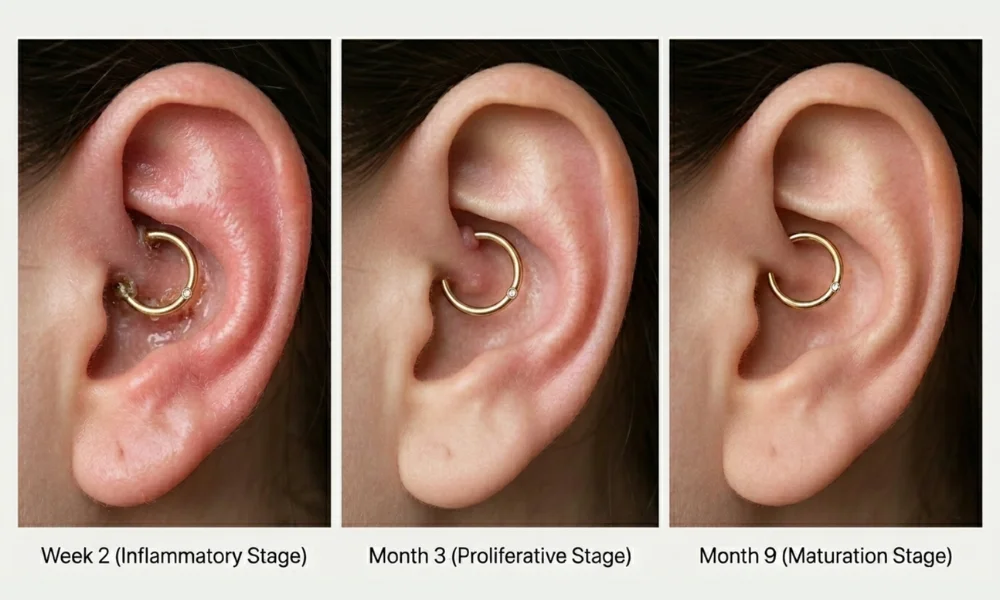
Stage 1: Inflammatory Phase (First 4 Weeks)
In this period of the healing process, your body will remain highly sensitive and reactive to everything around it. Redness, swelling, tenderness, pain, and throbbing can occur and are especially pronounced when lying down at night.
The presence of liquid (lymph) in the form of a white substance surrounding the jewelry will form crusties when dried this is normal and not an indication of infection.
This is the most important stage for your daith piercing healing time, as during this period, your body is only starting to create a fistula that will later accommodate your jewelry. Handle it carefully, as if it was a new surgical site.
Stage 2: The Proliferative Phase (Months 1 to 6)
The swelling should have gone down by now, but don’t let that fool you. This is the outside-in stage. The skin looks smooth and healed on the outside, but the tissue inside is still very weak.
This is where one of the biggest daith healing problems happens: people think they are healed and stop taking care of it or start sleeping on the ear. The inner fistula is still very small and thin because cartilage heals from the outside in.
Your daith piercing may still be a work in progress six months later, even if it looks great. During these middle months, being consistent is the best thing you can do.
Stage 3: The Maturation Phase (Months 6 to 12+)
Your piercing should feel settled by the end of the last stretch. You won’t feel that sharp pain when you clean, and the constant crusting should finally stop. But the cartilage is still getting thicker and stronger.
For a lot of people, this phase can last up to 18 months. Your piercing is only really seasoned when you don’t feel any pain for several weeks in a row and there is no more discharge. If you’ve gotten this far, the piercing’s permanent shape is finally set.
Factors That Affect Your Daith Piercing Healing Time
Most people assume how long to heal a daith is a fixed number, but your biological mileage can be quite different. The way of life and general well-being make all the difference between reaching the 6-month or the 18-month milestone.
Age and Immune Well-being
The aging process affects regeneration negatively. As a rule, teenagers recover tissues quickly, while older individuals need more daith piercing healing time. Moreover, autoimmune diseases and diabetes alter the inflammatory reaction, resulting in flare-ups.
Diet and Hydration
Your skin is an organ that requires fuel to rebuild. To speed up the daith healing stages, prioritize:
Zinc and Vitamin C: Critical for collagen synthesis.
Hydration: Water keeps the skin elastic and helps flush out cellular waste. Treat your healing period like recovery from a minor surgery if you are not fueling your body, your ear would not have the resources to repair that fistula.
Materials and Size of Jewelry
The metal inside your ear is the key to your success. Titanium or solid 14k gold are always recommended. Inferior quality surgical steel tends to contain nickel, which is highly irritating. Likewise, a piece that is too tight will irritate the piercing site, while jewelry that is too loose will snag your hair.
Lifestyle Habits That Slow Daith Piercing Healing Time
If you are wondering why you are struggling with daith healing problems, it is often due to these silent progress-killers:
-
Sleeping on it: This is the first cause of irritation bumps. Pressure restricts blood flow and shifts the angle of the jewelry.
-
Earbuds and AirPods: Direct pressure from earbuds disrupts the forming tissue. Avoid them for at least the first 2–4 months.
-
Beauty Products: Dry shampoo, hairspray, and conditioner residue are chemical irritants. Rinse your ear thoroughly after every shower.
-
Premature Jewelry Changes: Swapping your ring before the daith piercing 6 months milestone can literally tear the immature fistula, resetting your progress to day one.
Normal Daith Piercing Healing Signs vs. Infection: Know the Difference
Distinguishing between regular healing phases of daith piercing and actual problems with your health is how you will be able to minimize stress to an absolute minimum. Being predisposed to form crusties, this part of your body may seem problematic sooner than it really should.
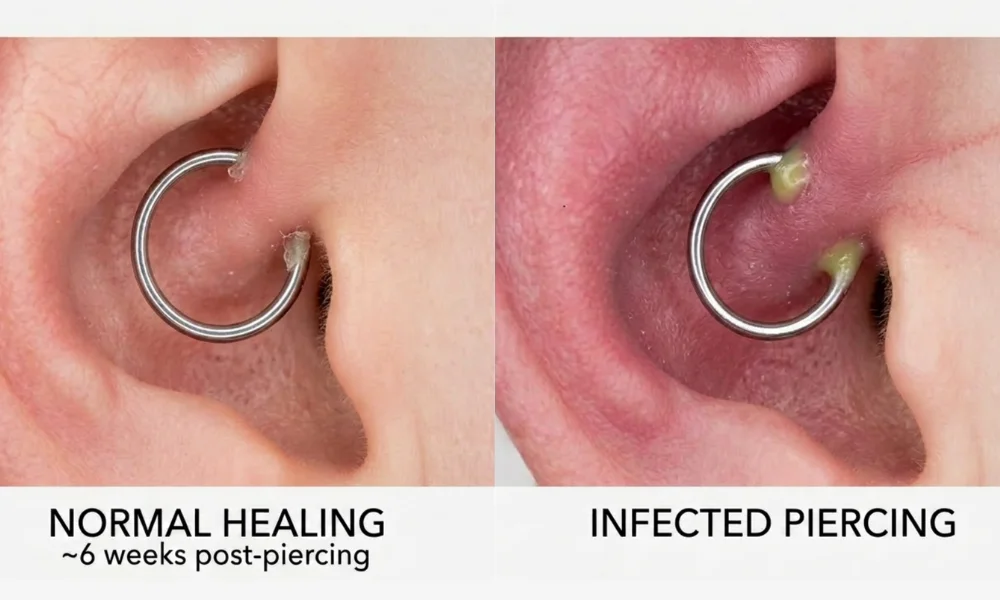
Is It Healing or Infected?
| Normal Healing Signs | Warning Signs of Infection |
| Clear or white crust (dried lymph fluid) | Green or yellow pus (thick, foul discharge) |
| Mild tenderness during your cleaning routine | Intense, throbbing pain that gets worse |
| Occasional itching as the tissue knits together | Skin is hot to the touch and deep purple/red |
| Slight swelling during the first month | Red streaks spreading away from the piercing |
| Minimal redness that fades week-over-week | Fever, chills, or swollen lymph nodes |
The Golden Rule of Recovery
One effective method of knowing how long it will take for the healing process of a daith piercing is to observe any downward trend in sensitivity. This means that if you feel that your ear is getting slightly better with each passing week, then things are going well.
But if the pain gets worse, or there are no improvements even after two weeks of proper aftercare, see a professional piercer or your physician without delay.
Important Point: In case you think that there is an infection, do not take out the jewelry from the hole because it is acting like a drain for your wound. The best way to avoid an abscess is to leave the jewelry where it is supposed to be placed.
Does Daith Piercing Healing Time Affect Migraine Relief?
Many go for this piercing due to the belief that the daith piercing stimulates the same pressure point that is targeted by acupuncture. In case your motivation for undergoing the piercing is based on health concerns, then it’s very important to know about daith piercing healing time effects on these health benefits.
The Effect of Inflammation
The inflammation associated with daith piercing takes place during the initial healing phases, which are between the first and fourth months of daith healing stages. The ear being under repair and being constantly inflamed, any effect on migraines can easily be overruled.
How Long Should You Wait Before Judging Results?
As for judging whether the daith piercing is working, it is going to take quite some time. Many professionals advise judging the effectiveness of the piercing once it reaches the maturation stage.
Months 1-4: High levels of inflammation; not a reliable period to measure the results of piercing.
Month 6: 6 months of daith piercing is when the tissue should be fully developed for evaluation purposes.
After Month 12: When the piercing is completely seasoned.
As there is no significant scientific evidence about the effectiveness of daith piercings for migraines, one thing that can be done is measuring it once the piercing has fully healed.
How to Speed Up Daith Piercing Healing Time
Biological repair cannot be skipped; however, setbacks leading to twice the amount of daith piercing healing time can be avoided by following the above suggestions.
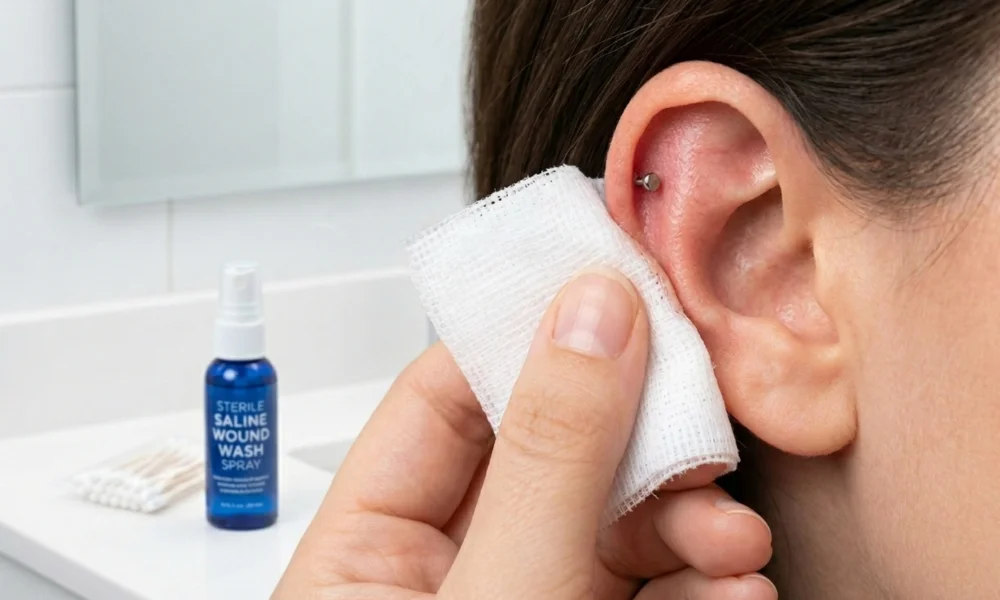
Proper Cleaning: Twice Daily
Forget about home-made solutions, alcohol, hydrogen peroxide, tea tree oil, and even cotton balls. The only solution to clean your piercing should be sterile saline spray (0.9% sodium chloride). Apply it to the front and back of the piercing, wait for 30 seconds to soften the crusties, and dry using a paper towel.
Travel Pillow Technique
The most important factor to consider during the process of healing is that there should not be too much pressure on the piercing site. If you sleep on your side, buy yourself a donut-shaped travel pillow. By placing the pierced ear in the middle hole, you will eliminate mattress contact, which creates irritation bumps. You might reduce your recovery time by weeks through this small change.
Downsize at the Right Time
To avoid micro-tearing, your initial jewelry should be oversized. After the period when swelling occurs passes, usually at week 6 or 8, visit your piercer and get smaller jewelry. Overly long jewelry often snags and shifts into the fistula, resulting in
Skip the Earbuds
Direct pressure from AirPods or earbuds disrupts tissue formation and traps bacteria. During the most active daith healing stages, switch to over-the-ear headphones. Avoid putting anything inside your ear canal for at least the first three months to prevent common daith healing problems.
Conclusion
In the end, daith piercing healing time takes a long time, usually between 6 and 12 months, and sometimes even longer. Most of the time, problems happen when the surface looks clear, which makes people think they skipped the daith healing stages too soon.
You can get through the process easily by following the three-phase healing model, buying high-quality titanium or gold, and sticking to your saline routine. If you’ve had your daith pierced for six months and are ready for a change, check out our selection of implant-grade jewelry at daithpiercing to find the perfect look for you.
Frequently Asked Questions
Is my daith piercing infected or just healing?
Normal healing involves clear crusties and mild redness that fades over time. An infection presents with thick yellow or green pus, intense heat, and throbbing pain that gets worse instead of better.
Why is my daith piercing still sore after 6 months?
At the daith piercing 6 months mark, the internal tissue is often still maturing and remains sensitive to pressure. Persistent soreness usually means the fistula hasn’t fully toughened up or is being irritated by sleeping habits or hair products.
What does a fully healed daith piercing feel like?
A fully healed piercing feels completely painless, even when the jewelry is moved or rotated during cleaning. You’ll know you’ve finished the daith healing stages when no crust forms and the skin looks identical to the surrounding ear tissue for several weeks.
Can I wear AirPods with a healing daith piercing?
Avoid AirPods for at least the first 3 to 4 months of your daith piercing healing time to prevent irritation. The physical pressure and trapped bacteria from earbuds are leading causes of painful bumps and delayed recovery.
Does daith piercing healing time differ between left and right ear?
The biological daith piercing healing time is the same for both, but your favorite sleeping side will often heal slower. Constant pressure on one side creates micro-trauma, making that ear more prone to daith healing problems compared to the other.