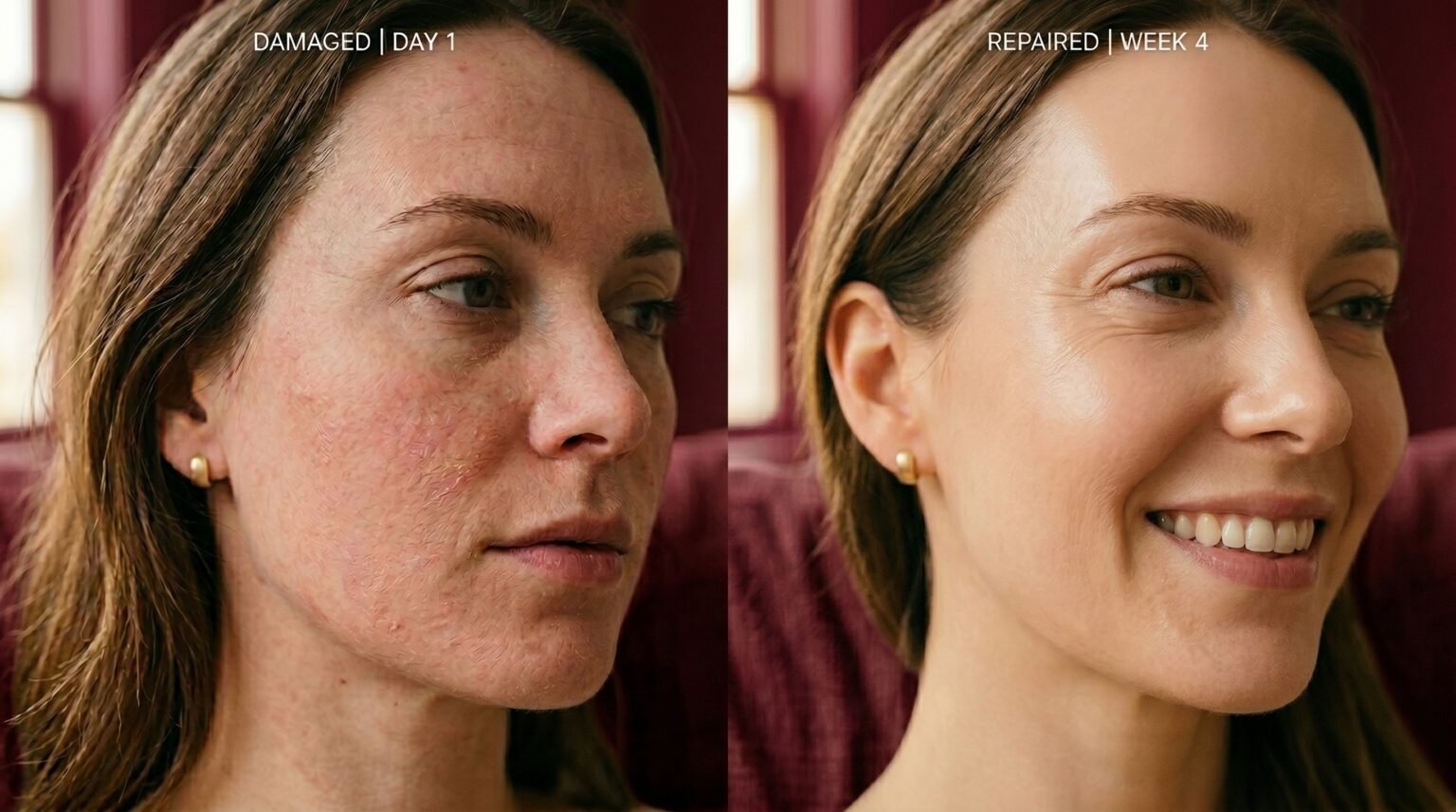
To repair skin barrier damage, pause every active ingredient, switch to a fragrance-free cleanser, and apply a ceramide moisturizer twice a day. Add SPF 30 each morning. Most people see real results in 2 to 4 weeks with ceramides, niacinamide, and hyaluronic acid.
Tight skin after washing. Stinging from a moisturizer that worked fine last week. Random redness that just will not calm down. Sound familiar? That is what a broken barrier feels like.
So if you have been wondering how to repair skin barrier damage without burning cash on serums, you are in the right place. At DaithPiercing,we dug through dermatology studies and product data from the past year. We pulled out what actually works, and tossed the hype.
What Is the Skin Barrier and Why Damaged Skin Barrier Symptoms Appear
Your skin barrier is the outermost layer of your skin. Doctors call it the stratum corneum.
Picture a brick wall for a second. The bricks are skin cells. The mortar holding them together is made of ceramides, cholesterol, and fatty acids. When the wall stays strong, water stays in and bad stuff stays out.
But once the mortar starts crumbling, water leaks out through tiny gaps. Dermatologists call this transepidermal water loss, or TEWL. At the same time, pollution, allergens, and bacteria sneak in through those same cracks. So damaged skin barrier symptoms show up fast.
Most of the time, the trigger is a mix of harsh products, dry weather, and habits you do not even think about. Hot showers count. So does scrubbing your face with a rough towel. Once the wall cracks, your skin cannot hold moisture or push back against pollution. That is exactly why your face feels rough, looks tired, and burns the moment you put cream on it.
Skin Barrier vs Moisture Barrier: Are They the Same Thing?
These terms get tossed around all over Instagram and TikTok, but they are not the same. The skin barrier vs moisture barrier difference is small. Yet worth knowing if you shop smart. Your skin barrier is the full stratum corneum, including cells, lipids, and proteins. Your moisture barrier is only the lipid part that traps water inside.
Here is the easy way to remember it:
- Skin barrier: the full protective shield that blocks germs, pollutants, and water loss
- Moisture barrier: one layer of that shield, focused only on holding hydration
- Both rely on ceramides, fatty acids, and cholesterol to function
Skincare brands love mixing these terms up in their marketing. So when you read moisture barrier cream on a label, it usually means the same thing as a regular barrier repair product.
Just flip the bottle around. Read the ingredient list. That tells you the truth.
10 Damaged Skin Barrier Symptoms You Should Never Ignore
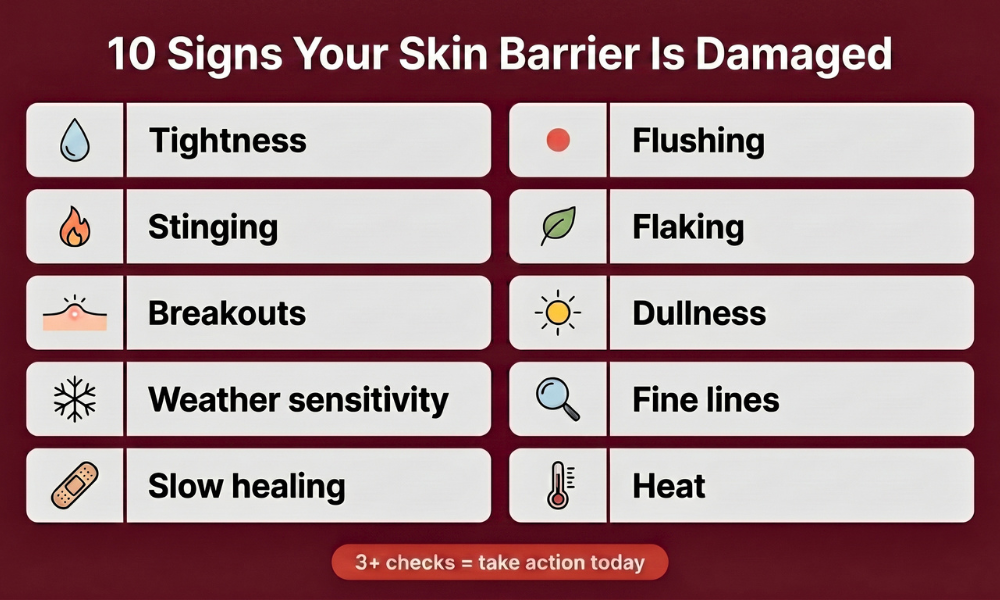
If you can check three or more of these damaged skin barrier symptoms, your skin needs help today.
Most people miss the early signs. Then they keep using actives until things really go downhill.
Here is the checklist dermatologists actually use:
- Your skin feels tight right after cleansing
- Products that never bothered you suddenly sting
- Redness keeps flaring up for no clear reason
- Flaky patches show up even after you moisturize
- New breakouts pop in spots you usually never break out
- Your skin looks dull instead of glowy
- Itching gets worse when the weather shifts
- Fine lines seem to appear out of nowhere
- Small cuts or pimples take forever to heal
- Your face feels warm or hot to touch
Three checks? Mild damage.
Five or more? Real trouble.
Above seven? Act today, not next week.
The good news is that most damage reverses fast with the right routine.
What Causes a Broken Skin Barrier (and Why You Need Treatment Now)
Before you start any broken skin barrier treatment, you need to find what caused the mess in the first place. Most people are doing several things wrong at once and have no clue.
Over-exfoliation is the biggest culprit. Scrubs, glycolic acid, and salicylic acid wear down the lipid mortar fast when used too often.
Then comes active stacking. Layering retinol with vitamin C and acids in the same routine is just too much for normal skin to handle.
Hot water makes everything worse. Long steamy showers strip your natural oils in minutes, and over-cleansing finishes the job.
Harsh ingredients add another layer of damage. Sulfates like SLS, denatured alcohol, synthetic fragrance, and essential oils show up in cleansers and toners that look gentle on the front of the bottle.
Environmental stress matters too. UV rays, city pollution, dry indoor heating, and wind all chip away at the barrier even when your routine looks clean.
Then there are the internal triggers most people ignore. Poor sleep, chronic stress, sugar binges, and not enough water slow down the skin’s repair work from the inside.
So most people hit three or four of these without realizing it. Spot your trigger first. Removing it is half the fix. The other half is rebuilding what got lost, and that starts with the routine right below.
How to Repair Skin Barrier in 7 Dermatologist-Approved Steps
This is the core routine for how to repair skin barrier damage at home. Follow it for 2 to 4 weeks straight. No swapping in fancy serums halfway through. No trying that new acid your friend swears by. Just consistency.
- Pause every active ingredient. Retinol, vitamin C, AHAs, BHAs, benzoyl peroxide. All of it. Today.
- Switch to a cream-based fragrance-free cleanser. No foaming gels.
- Wash with lukewarm water only. Cold shocks the skin, hot strips it.
- Pat dry with a clean soft towel. Never rub.
- Apply a hydrating serum on damp skin. Hyaluronic acid or glycerin works best.
- Seal everything in with a ceramide-rich moisturizer right after.
- Use mineral SPF 30 or higher every single morning, no exceptions.
That is the daily playbook. Simple, boring, and effective. Now let us break it down by time of day.
How to Repair Skin Barrier with a Morning Routine
How to repair skin barrier with morning skincare, answer is mornings should be quick and minimal.
Skip the cleanser if your skin feels fragile. Just splash with lukewarm water and pat dry. Apply a hyaluronic acid serum while your skin is still damp. Layer a ceramide moisturizer on top. Finish with mineral SPF 30, even on cloudy days.
That is five steps and four minutes total. The goal is hydration plus sun protection, nothing extra. Save the fun stuff like vitamin C or peptides for later, once your skin feels like itself again.
How to Repair Skin Barrier with a Night Routine
Your skin does most of its repair work while you sleep. So night care matters more than morning care in some ways.
Start with a gentle cream cleanser to lift off sunscreen, sweat, and grime. Then apply a hydrating toner or essence to wake up moisture absorption. Follow with the same ceramide moisturizer you used in the morning. For really dry patches, dab a thin layer of petrolatum on top. People call this slugging on TikTok, and it actually works.
It locks in everything underneath while you sleep. Once your barrier heals, you can level up to the steps in our Glass Skin Routine guide.
How to Repair Skin Barrier through Skin Barrier Ingredients
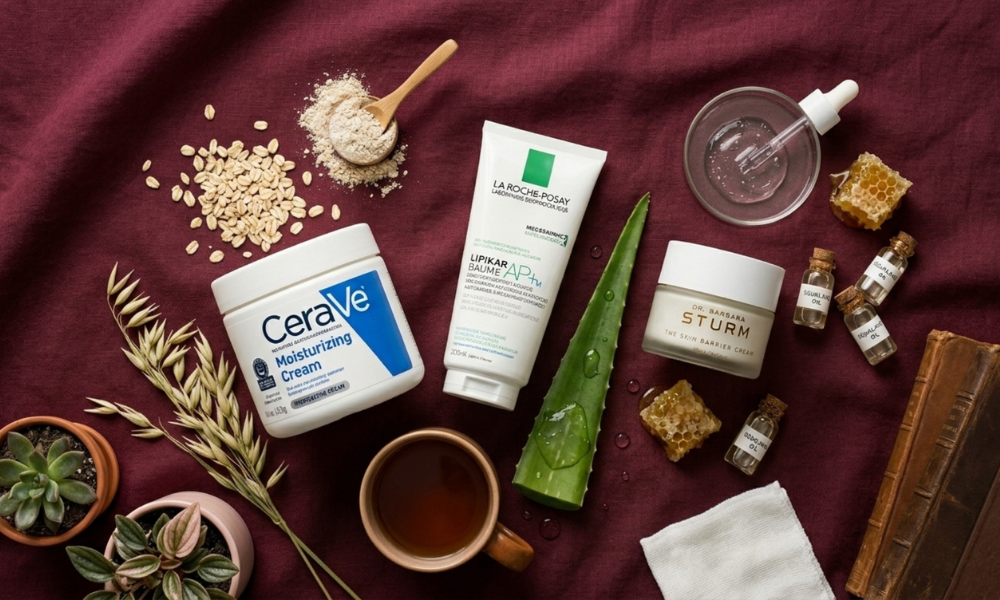
Some skin barrier ingredients carry all the weight. Others just sound nice on a label.
So focus your money on these eight. Each has clinical research behind it, and most cost less than twenty dollars at any drugstore.
| Ingredient | What It Does | Best For | Found In |
|---|---|---|---|
| Ceramides (1, 3, 6-II) | Rebuild lipid mortar between skin cells | All skin types | CeraVe, Dr. Jart+, Skinfix |
| Niacinamide | Boosts natural ceramide production 4 to 5 fold | Acne-prone, sensitive | The Ordinary, Paula’s Choice |
| Hyaluronic Acid | Pulls water into upper skin layers | Dehydrated, dry | La Roche-Posay, Vichy |
| Panthenol (Pro-Vitamin B5) | Calms inflammation, speeds healing | Reactive, post-procedure | Bepanthen, Skin1004 |
| Squalane | Mimics natural skin oils, seals moisture | Dry, mature skin | Biossance, The Ordinary |
| Glycerin | Holds water up to 10 times its weight | Every skin type | Most basic moisturizers |
| Cholesterol | Completes the lipid trio with ceramides | Mature, very dry | EpiCeram, derm formulas |
| Petrolatum | Cuts water loss by up to 99 percent | Severe damage, nighttime | Vaseline, Aquaphor |
Pick at least three and rotate them through your routine. Ceramides plus niacinamide plus hyaluronic acid is the strongest starter combo for any skin type. Hands down.
Best Moisturizer for Damaged Skin Barrier and Top Skin Barrier Repair Products
The best moisturizer for damaged skin barrier repair has two things: ceramides plus humectants, with zero fragrance.
So skip anything that smells like perfume. Even if it costs a hundred dollars. A solid ceramide moisturizer for barrier repair beats every plain hydrator out there. Why? Because it replaces the actual missing lipids in your skin instead of just adding water on top.
Here are three picks across price points:
- Budget pick: CeraVe Moisturizing Cream. Three real ceramides, hyaluronic acid, no nonsense formula. Under fifteen dollars.
- Mid-tier: La Roche-Posay Toleriane Double Repair. Great for sensitive or combination skin. Around twenty-two dollars.
- Splurge: Skinfix Triple Lipid-Peptide Cream. Loaded with lipids, peptides, and slow-release ceramides. About sixty dollars.
These three sit at the top of nearly every dermatologist’s list of skin barrier repair products. They have the right ingredients at the right doses.
Want a head-to-head between the two most popular drugstore options? Read our full comparison at La Roche Posay vs CeraVe.
How Long to Repair Skin Barrier Damage: Real Day-by-Day Timeline
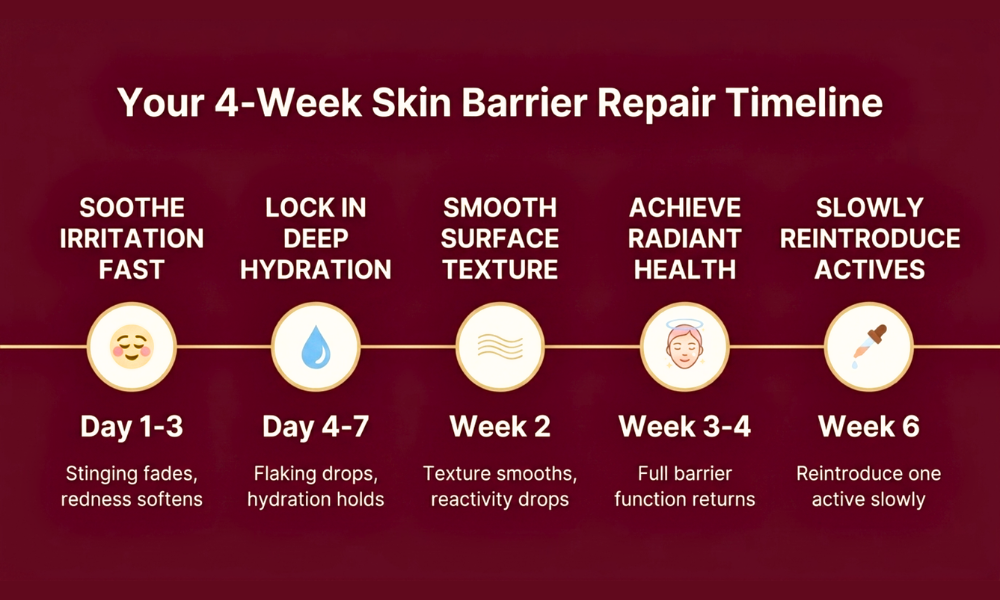
So how long to repair skin barrier damage really takes depends on how bad things got. Most people see early relief within 3 to 5 days. Real shifts kick in by week two. Full repair lands around the four-week mark.
Here is what to actually expect:
- Days 1 to 3: Stinging fades. Redness softens. Skin starts feeling calmer.
- Days 4 to 7: Flaking drops off. Hydration finally holds for hours.
- Week 2: Texture smooths. Reactivity to products drops a lot.
- Weeks 3 to 4: Full barrier function returns. Skin feels normal again.
- Week 6: Reintroduce one active slowly, starting at twice a week.
Stick to the plan. No skipping ahead.
Do not sneak retinol back in on day ten just because you got impatient. Real repair needs the full window, and rushing it just resets the clock back to day one.
How to Repair Skin Barrier for Different Skin Types and Real Situations
Not every face needs the same plan. So match your how to repair skin barrier routine to your actual skin type for faster results:
- Sensitive or rosacea-prone skin: Stick to ceramides and panthenol only. Add azelaic acid after week four if redness lingers.
- Oily and acne-prone skin: Pick gel-cream ceramide formulas. Skip petrolatum and skip slugging.
- Mature skin: Layer squalane plus ceramides plus cholesterol. Add a peptide serum once healed.
- Post-procedure skin (peel, microneedling, laser): Use only three products for two weeks. Cleanser, moisturizer, SPF. Nothing else.
- Allergy-triggered damage: Pollen, dust, and pet dander spike barrier issues fast. Our full guide on Skin Barrier Repair for Allergies walks through every seasonal trigger.
- Post-piercing sensitivity: Keep moisturizer off the actual healing piercing wound. But you can keep using ceramide cream on the rest of your face without any worry.
When Broken Skin Barrier Treatment Needs a Dermatologist
Sometimes home care just is not enough. So if your barrier is still a mess after four weeks of strict care, book a dermatologist visit. Same goes if your skin starts oozing, weeping, or crusting over.
Severe stinging that wakes you up at night counts as a red flag. Redness that keeps spreading instead of fading? Same thing. Swelling, warmth, or anything that looks like pus could mean infection, and you need to be seen this week.
A dermatologist can prescribe topical steroids, medical-grade ceramide creams, or oral medication if something deeper is driving the damage.
Some clinics also offer LED light therapy, hydration facials, and post-procedure boosters. These calm severe barrier damage much faster than any drugstore cream can on its own.
Do not wait it out longer than four weeks either. Skin that stays inflamed too long can develop chronic issues like eczema or dermatitis. Those are much harder to reverse once they settle in.
Final Thoughts on How to Repair Skin Barrier
Fixing a damaged barrier is not about chasing miracle products. It is about doing less, picking smart ingredients, and trusting the 2 to 4 week timeline even when you feel impatient.
So drop the actives. Stock up on ceramides. Drink your water, sleep more, and let your skin breathe for a change. For more dermatologist-backed routines and product breakdowns, explore the skin care hub at DaithPiercing
Frequently Asked Questions
Can a damaged skin barrier heal on its own?
Yes. Stop actives, use a ceramide moisturizer twice a day, and wait. Most barriers heal in 2 to 4 weeks. Severe damaged skin barrier symptoms like cracking or eczema flares need a dermatologist.
Is Vaseline good for repairing the skin barrier?
Yes, as a sealant. Petrolatum cuts water loss by up to 99 percent. Apply a thin layer over your ceramide moisturizer for barrier repair at night. It locks in hydration but does not replace ceramides.
How long does it take to repair skin barrier damage?
So how long to repair skin barrier damage really takes? Early relief in 3 to 5 days, full repair in 2 to 4 weeks. Severe damage stretches to 6 or 8 weeks if you stay consistent.
What are the worst ingredients for a broken skin barrier?
Stay away from denatured alcohol, sulfates like SLS, synthetic fragrance, essential oils, glycolic acid, salicylic acid, retinoids, and benzoyl peroxide while repairing. Once your barrier feels normal again, bring back just one product at a time. Twice a week is the safest starting frequency for any new active.
What is the fastest way to repair skin barrier damage?
The fastest way how to repair skin barrier damage is to drop all actives today, switch to a fragrance-free cream cleanser, and layer ceramides plus hyaluronic acid morning and night. Add SPF 30 daily. Visible results in under 7 days.