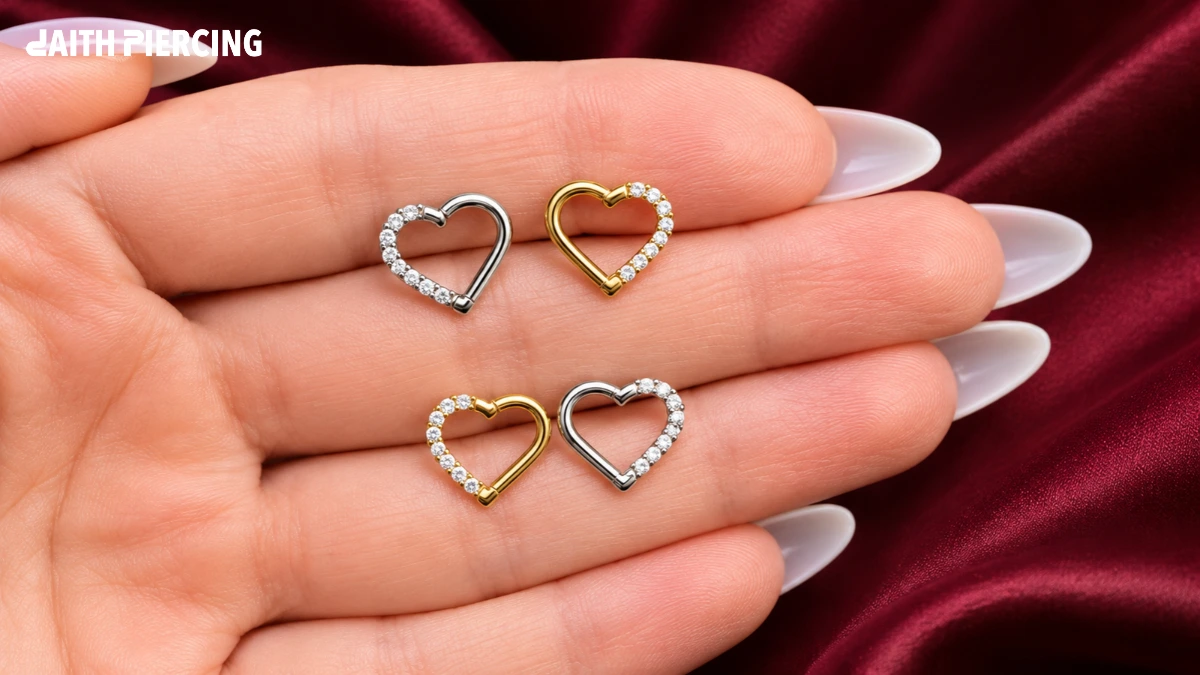
Learning how to compare daith heart rings before you buy comes down to one principle that changes everything: you are not comparing two rings, you are comparing two symbols, and symbols are far less forgiving than circles.
A plain ring hides its flaws. If the polish is slightly lazy on one side of a seamless hoop, nobody on earth will ever notice, because a circle is a circle at every angle. A heart hides nothing. If one lobe is a fraction fuller than the other, if the point drifts a millimeter off center, if the cleft sits too shallow or too deep, the human eye catches it instantly.
We are wired to read hearts the way we read faces, as whole shapes, and a slightly wrong heart reads the way a slightly wrong smile reads. That is why comparing heart rings deserves its own method, and why the method starts with meaning.
The meaning tax
Here is an honest idea from our guide to what fine jewelry costs: bold symbolic designs carry a hidden premium, and you should demand more from them, not less. Call it the meaning tax. The more a shape says, the more a flaw in it says. A lopsided plain hoop is still a hoop. A lopsided heart announces that the heart is lopsided, and no amount of gold weight can rescue that message.
So when you compare heart ring candidates, raise the bar you would use for plain rings. Score symmetry double. Hold the point construction to the strictest version of the test. The meaning tax is not a reason to avoid heart rings. It is a reason to compare them more carefully than anything else in the case.
The silhouette standard
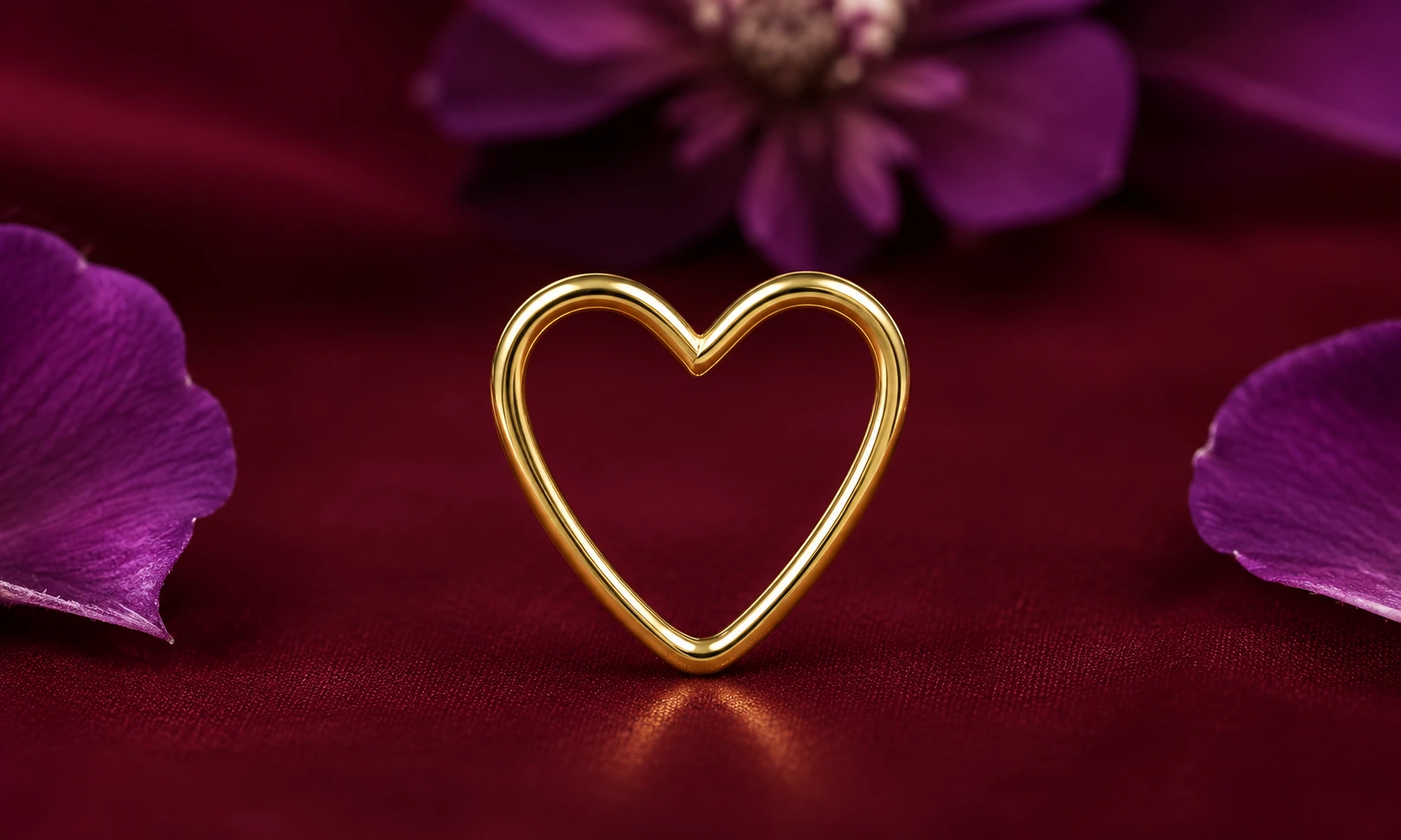
This is the single most useful comparison trick I know for shaped jewelry, and I have never seen it printed anywhere. Take the three heart rings you are considering and look at each one in silhouette. Either photograph the candidates against a white background and squint, or simply hold each ring between your eye and a bright window so the metal reads as a solid dark shape.
A well designed heart is legible the instant it becomes a silhouette. The lobes curve honestly, the cleft reads clearly, the point lands centered, and the whole shape feels like the symbol you learned to draw as a child. A poorly designed heart becomes vague in silhouette, the lobes blur into each other, the point drifts, and the shape could almost be a leaf or a lopsided pear.
If two hearts compete in your cart, the silhouette test ends the contest in under a minute, because it strips away the gold color, the stones, and the photography, and leaves only the design itself.
The five things worth scoring, with symmetry doubled
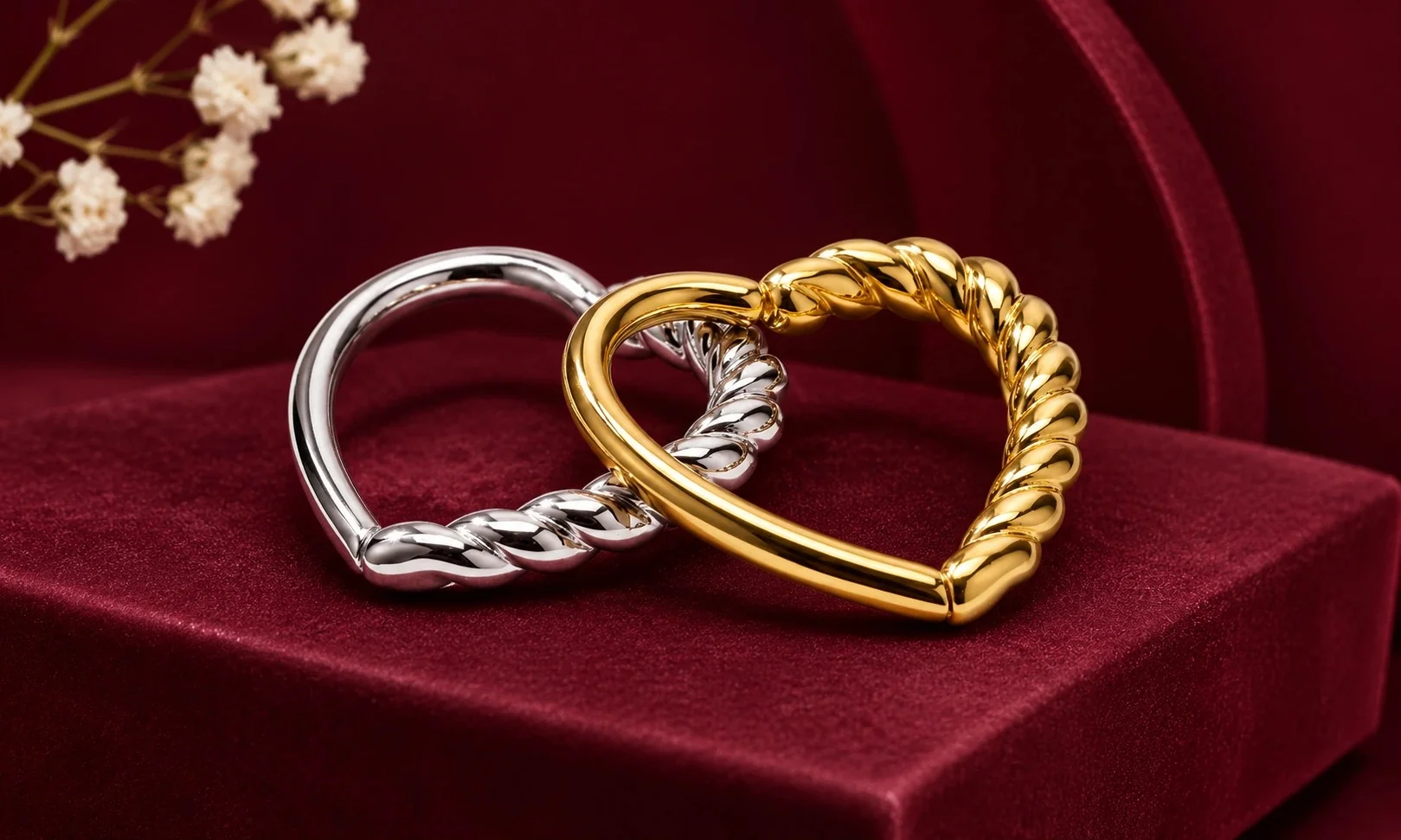
The friction map method from our clickers guide still applies to heart rings at the lifestyle level, because your pillow and your headphones do not care what shape you wear. But at the piece level, heart rings need their own scorecard. These are the five things to compare, in order of how much they move the result.
- Symmetry, scored double. Place both rings on a white surface and compare lobe to lobe, side to side. Measure with your eyes, not a ruler. The winner is the ring whose two halves mirror each other without you having to convince yourself they do.
- Point construction. This is where our heart ring buyer’s guide earns its keep: the point test. Solid continuous metal at the tip, no seam, no step, and the hinge living anywhere except near the point or the cleft. A candidate that fails here is eliminated before price even enters the conversation.
- Cleft depth and finish. The cleft of a heart is its signature, and it has two failure modes. Too shallow, and the ring reads as a rounded blob instead of a heart. Too deep and too narrow, and it becomes a hair trap that dulls within weeks. Compare candidates for cleft sharpness, and then drag a cotton swab through each one. The swab reveals finishing that your eyes miss.
- Proportion, not just diameter. Two heart rings with identical inner diameters can look completely different on an ear, because the heart design occupies more of the ring’s circumference than a plain shape. When torn between sizes for a heart, remember the size up rule from the buyer’s guide, and compare candidates by how much heart will actually show in your fold, not by the number on the listing.
- Rotation behavior. Here is something almost nobody checks before buying. Hearts have a direction, which means they have a wrong direction. Gently rotate each candidate twenty or thirty degrees and see what the shape becomes. A well designed heart still reads as a heart slightly off center. A poorly designed one collapses into a bent teardrop the moment it rotates, and rings always rotate a little during a long day. Compare this and you will never own a heart that points at your scalp by lunchtime.
Comparing prices when the shapes are equal
Sometimes two heart rings pass every test above and still sit at different prices. Now the comparison becomes honest math. Compare cost per wear over two years, exactly as our clickers pricing guide teaches. And remember that heart rings carry one extra price factor you should verify rather than assume: stones. A heart ring set with pavé along the lobes justifies a real premium over a plain gold heart of identical shape, because curved setting work is genuinely difficult. But if both rings are plain gold and both pass the five point scorecard, the price gap between them is mostly story. Buy the story only if you love the teller.
The gift comparison
A large share of heart rings are bought as gifts, which adds one comparison most guides ignore: compare the purchase routes, not just the rings. A ring ordered online needs the recipient’s numbers or it becomes a beautiful errand of exchanges. A commission or studio gift certificate carries the same symbolism without the sizing trap, as our fine jewelry holiday gift guide explains in full. If the gesture matters as much as the object, the certificate route often wins the comparison before the metal does.
The last thing I will tell you
Comparing heart rings is really comparing intentions. The shape announces why you bought it, to yourself every morning and to anyone close enough to see it. So take the silhouette standard seriously, score the symmetry double, test the rotation, and buy the heart that stays a heart even when your day turns it sideways. A symbol that holds its shape under real life is the only kind worth wearing. When you are ready, the whole collection of methods on this site gathers in our daith jewelry pillar guide.
Frequently asked questions
What matters most when comparing two daith heart rings?
Symmetry, scored double, then point construction. A heart with mirrored lobes and solid metal at the tip outwears and outshines a flawed design at any price. Run the silhouette standard on both candidates before any other comparison.
Is a plain gold heart ring better than a pavé heart ring?
For daily wear, usually yes. Plain gold hearts survive the friction map better, and their silhouette reads more cleanly. Pavé hearts win at evening and occasion wear, where their sparkle earns the extra weight and the extra maintenance.
How do I compare heart rings for a gift?
Compare purchase routes first. Online orders need the recipient’s sizes, which most gift givers do not have. A studio gift certificate or a commission deposit carries the same symbolism without the fit risk, which is why many gift givers choose the certificate route.
Do heart rings rotate out of position during the day?
Slightly, yes, which is why the rotation check matters. A well proportioned heart still reads as a heart when it shifts. Compare candidates by rotating each one twenty degrees and choosing the design that keeps its shape.
What size heart ring should I compare first?
Start from the numbers in your piercing passport, then favor the larger of two close diameters. Hearts need visible ring to read as hearts. Your piercer can confirm the best diameter for your fold in one short visit.