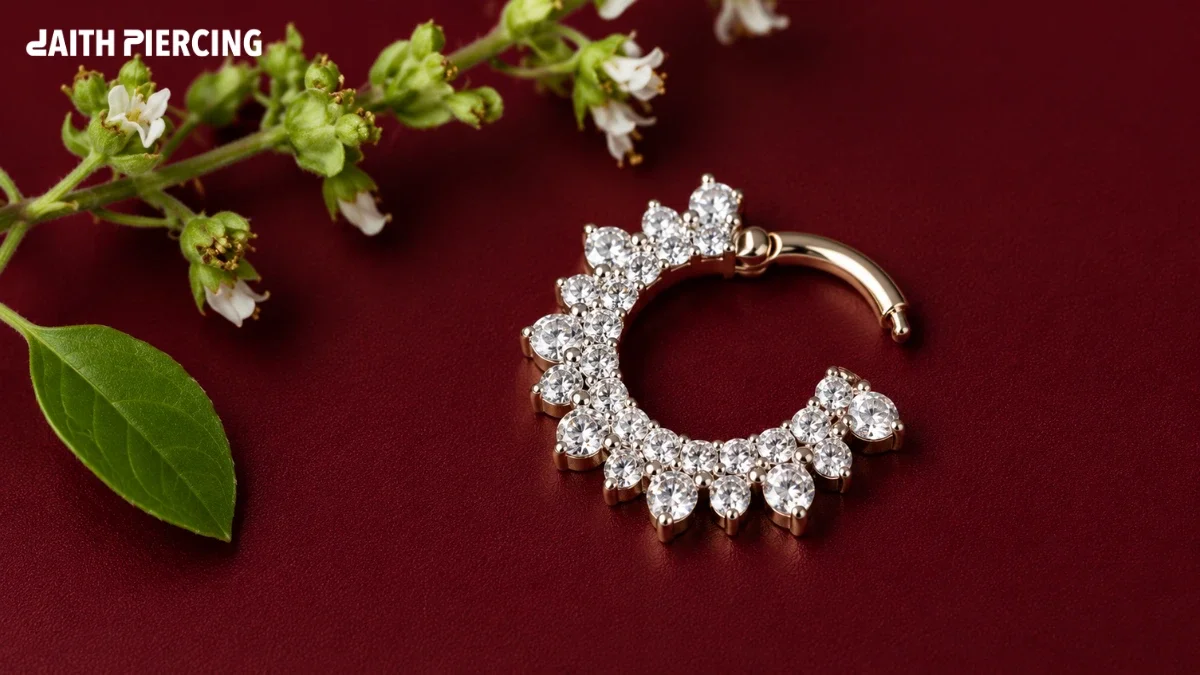
What makes Daith clickers Expensive is not the gold you can see. It is everything hiding underneath the gold, and until you can name those hidden things, every price tag will feel like a guess someone else made for you.
I still remember standing at a jewelry counter years ago, holding two clickers that looked, to my untrained eye, identical. One was $95. The other was $540. The salesperson said the word craftsmanship, and I nodded like I understood, and I did not understand at all.
That moment of quiet confusion, half shame and half suspicion, is why most people either overpay for the wrong ring or talk themselves out of the right one. This article exists so you never have to stand in that confusion again.
The price iceberg: what you see is only a third of the cost
Picture an iceberg. The part above the waterline is what every product page shows you: the metal, the stones, the brand name, the pretty photo. That visible part is real, and it is roughly a third of what you are paying for. The other two thirds sit below the waterline, invisible in photos, and they are the entire reason one ring outlives five years of daily wear while another dies in a season.
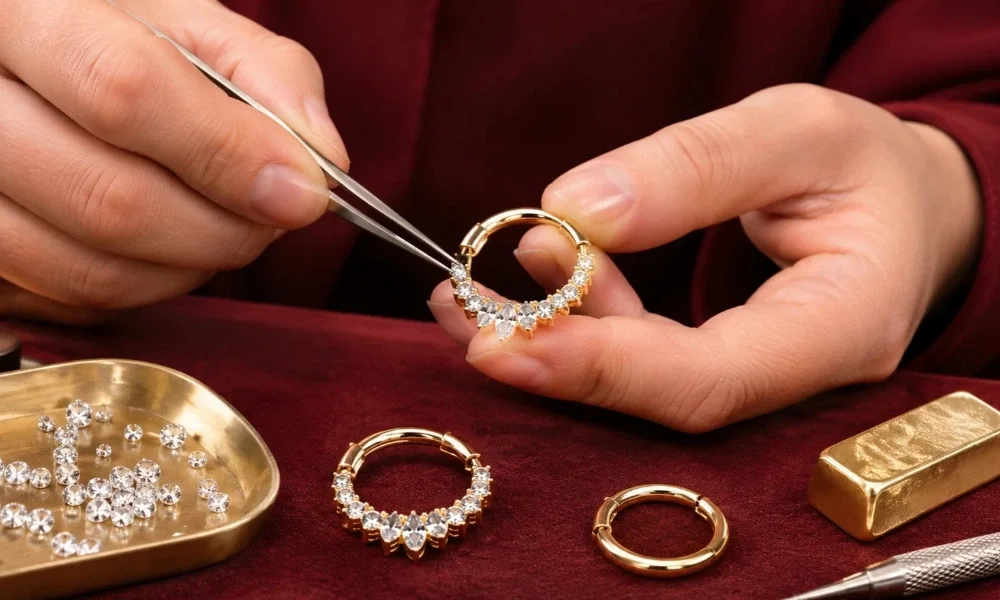
Here is what lives below the waterline. What makes Daith clickers Expensive: Hours you will never witness. A fine clicker passes through human hands at every stage: the maker who forms the ring, the setter who seats each stone under magnification, the finisher who polishes the inside of a circle barely wider than a coffee stirrer.
A premium ring carries somewhere between two and six hours of skilled labor. You are not buying gold. You are buying the afternoon of a person who has spent a decade learning to make something this small behave perfectly.
The cost of failure. Here is something almost no guide tells you. Small hinged parts fail at a surprisingly high rate during manufacturing. A hinge that binds, a seam that will not close flush, a clasp that loses tension, each of these means the entire ring, gold and stones and hours included, goes into the scrap tray.
Makers who care build this failure rate into their prices. Cheap manufacturers do not scrap anything. They sell their failures to you.
Material that becomes dust. Machining and finishing a tiny ring wastes a surprising amount of metal. Fine makers figure this loss into the price. Discount makers cheat it with thinner stock and lighter gold, which is why their rings feel different in your hand before they ever look different.
The warranty reserve. A serious maker expects a small number of rings to come home for repair, and they have already priced that promise into what you paid. When a $90 clicker breaks, you learn what the warranty was worth, which is nothing.
The rent on skill. Independent jewelry studios in expensive cities pay real rent for the benches where these rings are born. You are partly funding the continuation of a craft, and after years of collecting, I have come to see that as a feature, not a tax.
What makes Daith clickers Expensive: The five real cost drivers, ranked
If you want the iceberg in a list, here it is, in the order that actually moves price.
- Hand labor time. The single biggest driver. More human hours, higher price, longer life.
- Failure and scrap rate. Tight tolerances cost money because rejects are destroyed, not discounted.
- Stone setting quality. Pavé on a curved ring is genuinely difficult. Each stone is a small act of engineering.
- Material honesty. Solid alloy throughout versus plated or hollow construction.
- Batch size. A ring made in a run of twenty costs more per piece than one stamped out by the thousand. It will also fit better.
Notice what is not on that list: the brand name. Branding adds something, but less than people assume, and in fine body jewelry the respected names mostly charge for the first four items and use the fifth as proof.
When the premium is worth it: the thousand day rule

Now the question you actually came with. When should you pay the premium? I use one test, and it has never failed me. I call it the thousand day rule.
Ask yourself one honest question: will I wear this ring at least a thousand days in the next three years? A daily ring, the one our comparison guide’s friction map is designed to find, clears a thousand days easily. At that wear rate, a $500 ring costs fifty cents a day, and the premium pays for itself in comfort, in hinge life, in the absence of small daily annoyances. This is where craftsmanship earns its keep.
A ring that will rotate in and out, worn to dinners and parties, will not reach a thousand days. It might reach a hundred. On a hundred wears, even a beautiful $540 ring is a $5.40 per wear indulgence, which is fine if that is the intention, but it means the premium is buying pleasure, not value. Buy it with open eyes, as the treat it is.
The rule also protects you from the most expensive mistake in this niche: paying premium prices for a healing clicker you will swap out in six months. Initial jewelry is temporary by design, and solid implant grade titanium does that job beautifully for a fraction of the price.
When the premium is not worth it
Let me be equally honest about the other side, because a guide that only defends expensive rings is marketing, not teaching.
The premium is not worth it when you are still discovering your style. Your taste in two years will embarrass your taste today, guaranteed. Buy well made and modest now, learn what you love, and save the heirloom budget for the version of you that already knows.
It is not worth it when the sizing is a guess. An expensive ring in the wrong diameter is just an expensive mistake, and if you do not know your numbers yet, start with our guide on the questions to ask before you buy before any money leaves your account.
And it is not worth it when the ring fails the basics regardless of price. Run the ten second quality test from our premium buyer’s guide on any candidate. A $600 ring with a gritty hinge is an overpriced $60 ring wearing a good story.
The sweet spot most buyers miss
Here is the observation I will leave you with, and it is the one collectors know that the internet does not. The best value in daith clickers lives in the quiet middle: independent makers, solid 14k gold, no major brand name, prices roughly between $200 and $450. Above that band you increasingly pay for stones, brand prestige, and exclusivity. Below it you start gambling on the hinge.
In that middle band you get nearly all of the engineering and almost none of the markup. Our editors’ roundup of the best daith clickers of 2027 leans heavily into this band, and when you are ready to buy, our walkthrough on ordering daith clickers online safely keeps the money you saved from becoming its own lesson.
The last thing I will tell you
Price is not a judgment of your worth, and neither is the ring. The $95 clicker that makes you smile on a train platform is a success. The $540 one sitting in a drawer because the clasp scared you is a failure, no matter how fine the seam. Expensive is a tool, not a trophy. Spend the premium where your life will touch it every day, and spend lightly everywhere else. That is the whole philosophy, and it will quietly save you thousands over a collecting lifetime.
Frequently asked questions
Why are some daith clickers $60 and others $600?
The visible parts, gold and stones, explain only part of the gap. The rest is hand labor time, the cost of scrapping rings that fail during production, tight quality control, and small batch manufacturing. Cheap rings skip the invisible parts and sell you the failure rate.
Is an expensive daith clicker worth it for a first piercing?
No. Initial and healing jewelry is temporary by design, and implant grade titanium handles healing better at a fraction of the price. Save the premium budget for the upgrade you will wear for years.
Do brand name daith clickers justify their price?
Often partially. Respected names charge for real craftsmanship, but much of the premium over independent makers buys brand prestige and design exclusivity. Compare the hinge, seam, and interior polish rather than the logo, and the answer usually reveals itself.
What price range offers the best value in daith clickers?
For solid gold daily wear rings, the independent maker band between roughly $200 and $450 tends to deliver nearly all of the engineering with minimal markup. Above that, you increasingly pay for stones and name. Below it, hinge quality becomes a gamble.
How can I tell if a pricey clicker is actually well made?
Use the ten second test: one thumb should open the hinge smoothly, a fingernail dragged across the closed seam should feel almost nothing, and the ring should hold a true circle. Any $600 ring that fails those three checks is asking you to fund its marketing.