The best retinol for beginners is a low-strength formula you use slowly and stick with. Begin with 0.025% to 0.05% retinol or 0.05% retinaldehyde, two nights a week, then build up. Naturium and CeraVe top the drugstore picks, and Medik8 Crystal Retinal wins for a clear step-up path. Layer moisturizer every time, and wear sunscreen daily. Expect smoother texture and fading dark spots somewhere in the three to six month range with steady use.
Shopping for the best retinol for beginners is weirdly stressful. You stand there reading the same buzzwords on every bottle, and they all swear they will fix your skin. So which one is real? That is the question we kept hearing.
At DaithPiercing, we went deep. We read the derm advice, scrolled through hundreds of real reviews, and lined up the formulas that actually make sense for a first-timer. What you get below is the short version of all that digging.
Top picks for every wallet, a strength chart that finally makes sense, an easy starter routine, and the side effects most articles gloss right over. Want a fresh retinol serum 2026 launch or an old drugstore favorite? Either way, you will know what to buy by the time you scroll to the bottom.
What Is Retinol and Why It is the Best Retinol for Beginners to Know First
The best retinol for beginners is a low-strength one. Think 0.025% to 0.05% retinol, or a 0.05% retinaldehyde, sitting in a soft, barrier-friendly base. Use it twice a week to start. Build from there. And honestly? Skip the strongest bottle on the shelf. It will not do you any favors at the start.
Retinol comes from vitamin A. Put simply, it nudges your skin cells to act younger. It bumps up cell turnover, builds collagen, and helps clear out gunky pores. Give it a few months and you will notice it. Smoother skin. Fewer little lines. That lit-from-within look people chase.
Now here is the bit that confuses everybody. Retinol is not the active form of vitamin A, not yet. Your skin has to convert it first, and that takes a couple of steps. More steps means slower and gentler. Slower and gentler is exactly what a newbie wants. That is the whole reason it is such a friendly starting point. It also plays nice with calming ingredients, by the way. If you want to layer the right way, our guide on niacinamide vs vitamin C sorts out what belongs together and what does not.
Retinol vs Retinoid: What is the Real Difference?
People throw these two words around like they mean the same thing. They do not. Retinoid is the big umbrella term. Every vitamin A product lives under it. Retinol is just one option sitting under that umbrella. So yeah, all retinols are retinoids. But plenty of retinoids are not retinol. When folks ask the retinol vs retinoid question, what they really want to know is how strong it is and how fast it works.
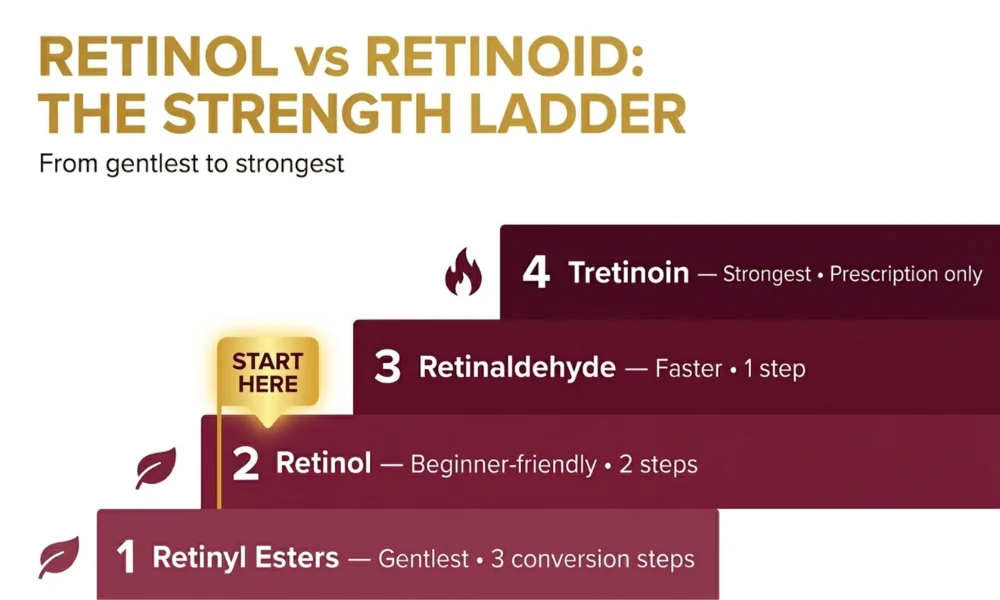
Here is the ladder, gentlest at the top:
| Type | Conversion steps | Strength | Prescription? | Best for |
|---|---|---|---|---|
| Retinyl esters | 3 | Weakest | No | Ultra-sensitive skin |
| Retinol | 2 | Moderate | No | Most beginners |
| Retinaldehyde | 1 | Stronger | No | Faster results |
| Tretinoin | 0 (active) | Strongest | Yes | Advanced users |
A beginner usually wants to camp out in that retinol or low retinaldehyde zone. Tretinoin? It works fast, sure. But it also stings and peels like crazy. Not a starting line.
How to Start Using Retinol: A Beginner’s Step-by-Step
Figuring out how to start using retinol comes down to one thing, mostly. Patience. Rush it and your face flakes and burns and you will swear off the stuff forever. Go slow and you build something that sticks for years. So here is the order:
- Patch test. Dab a little behind your ear or low on your jaw for a couple nights. Any redness? Wait it out.
- Wash your face and dry it all the way. Then wait fifteen minutes. Damp skin drinks it up too fast and that’s where irritation starts.
- Pea-sized amount. Whole face. More isn’t better, trust me on this one.
- Give it five minutes, then a plain moisturizer goes on top.
- Sunscreen every morning, no skipping. Retinol makes your skin touchier in the sun.
That is it. That is the method. Once it feels routine, you can fold retinol into something bigger. Our glass skin routine walks through how all the pieces stack up for that smooth, glassy finish.
How Often to Use Retinol When You are a Beginner
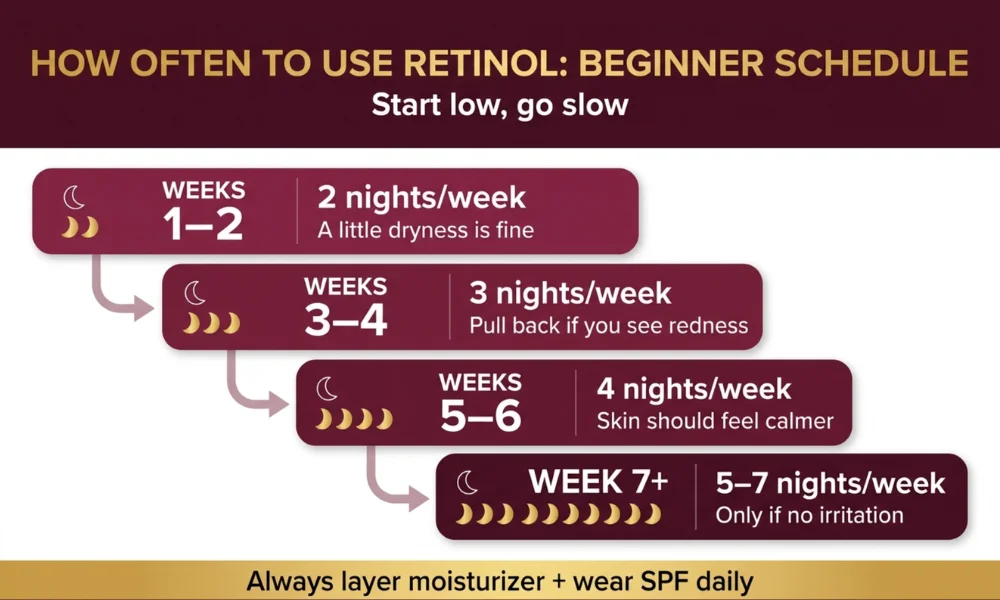
This is where most people trip and fall. They slap it on every single night from day one, and by week three their skin is throwing a fit. The whole game with how often to use retinol is easing in. Start small. Watch what your skin does. Add nights as you earn them.
| Week | Nights per week | What to watch for |
|---|---|---|
| Weeks 1 to 2 | 2 nights | A little dryness is fine |
| Weeks 3 to 4 | 3 nights | Real redness? Pull back |
| Weeks 5 to 6 | 4 nights | Skin should feel calmer |
| Week 7 onward | 5 to 7 nights | Only if you are not irritated |
Skin acting up? Drop back a level for a week. Then climb again, slow as you like. Nobody hands out medals for rushing this.
Retinol Percentage for Beginners: Which Strength to Pick
The numbers on the label trip up just about everyone. Bigger is not better, and for a first-timer it is usually worse. The right retinol percentage for beginners is low enough that you would not flare up, but real enough to actually do something. So here is what those tiny decimals mean in plain terms:
| Strength | Active | Skin level | Start frequency |
|---|---|---|---|
| 0.025% to 0.05% | Retinol | True beginner | 2 nights/week |
| 0.05% to 0.1% | Retinaldehyde | Beginner, faster results | 2 to 3 nights/week |
| 0.1% to 0.3% | Retinol | Building tolerance | 3 to 4 nights/week |
| 0.3% to 0.5% | Retinol | Comfortable user | 4 to 5 nights/week |
| 0.5% to 1% | Retinol | Long-term user | Nightly, built up slow |
One more thing worth saying. The base matters as much as the number, sometimes more. A nicely buffered 0.3% can feel kinder than a harsh little 0.1%. So read the whole ingredient list. Do not just chase the percentage on the front.
Choosing the Best Retinol for Beginners by Skin Type
Most guides breeze right past this part, and that drives me nuts, because it is the part that matters most. Your skin type decides which formula works for you. So match it to your actual face, not to whatever’s trending this week.
Best Retinol for Beginners with Oily or Acne-Prone Skin
Reach for a light serum or a gel. They sink in fast and would not clog you up. Retinol mixed with niacinamide is a smart combo here. The niacinamide calms breakouts while the retinol clears the backed-up pores. Heavy creams just sit on oily skin, so leave those alone.
Best Retinol for Beginners with Dry or Sensitive Skin
Go cream. Look for ceramides or squalane on the label. A low 0.05% retinaldehyde tends to be the safest way in for touchy skin. That extra moisture cushions the active, so your barrier does not freak out. And patch test twice before you go all in. No shame in being careful.
Best Retinol for Beginners with Mature Skin
Mature skin can usually take a bit more, but easing in still pays off every time. A 0.1% to 0.3% retinol in a rich, cushy base works great on fine lines. Stack it with other gentle anti-aging moves too, like the ones in our red light therapy skincare guide, and you will see a bigger payoff.
The 7 Best Retinol for Beginners to Buy in 2026
These picks land in that sweet spot. Real results, gentle touch. Any retinol serum 2026 release has to clear a high bar to make a list like this, and these all did. They run cheap to splurgy, so there’s a fit for every budget.
- Naturium Retinaldehyde 0.05%. A genuine beginner strength with ceramides and niacinamide baked right in. Gentle, cheap, dependable.
- The Ordinary Retinal 0.2% Emulsion. A budget retinaldehyde that fights way above its price. Go slow with this one though.
- CeraVe Resurfacing Retinol Serum. Encapsulated retinol plus ceramides. About as easy a first step as it gets.
- Avene RetrinAL 0.05. Built for reactive, flushy skin. Soothing and barrier-friendly.
- Medik8 Crystal Retinal 1. A clear step-up system that grows with you. Perfect if retinoids make you nervous.
- SkinCeuticals Retinol 0.3. A clinical classic for skin that’s ready to commit.
- RoC Retinol Correxion Night Cream. Cream and active rolled into one step. Simple, and it works.
Best Drugstore Retinol for Beginners on a Budget
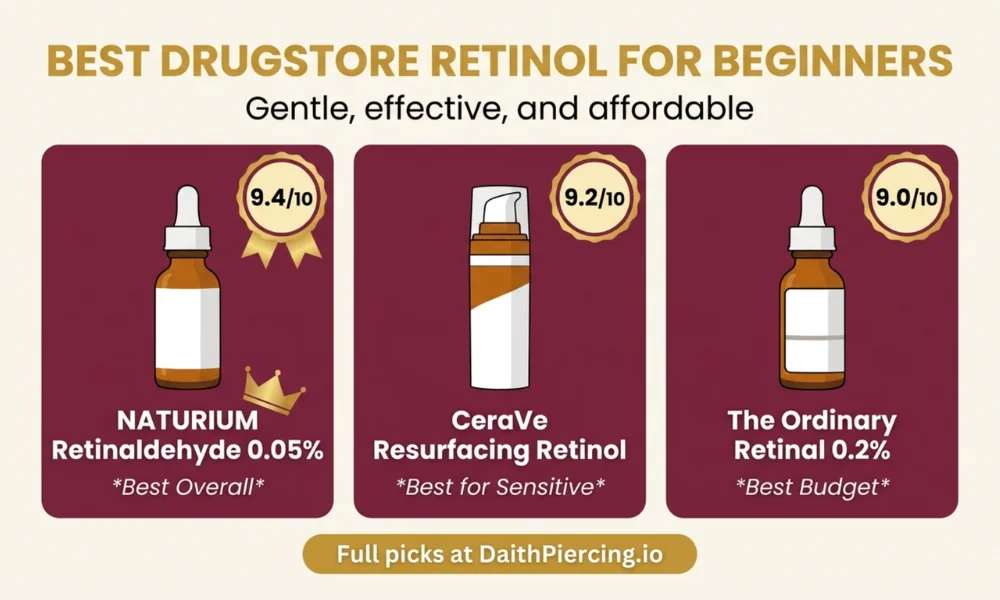
You really do not have to drop a fortune to start. The best drugstore retinol picks give you the real thing for the cost of a lunch out. CeraVe, The Ordinary, Naturium, they all undercut the premium brands and still deliver. They lean on encapsulated retinol and barrier helpers, so they stay gentle on new skin. Trying to pick between the affordable lines? Our La Roche-Posay vs CeraVe breakdown makes the call easier.
| Product | Active & % | Skin type | Price tier | Our rating |
|---|---|---|---|---|
| Naturium Retinaldehyde | 0.05% retinal | Beginner, sensitive | Drugstore | 9.4/10 |
| The Ordinary Retinal | 0.2% retinal | Budget, building up | Drugstore | 9.0/10 |
| CeraVe Resurfacing | Encapsulated retinol | Beginner, all types | Drugstore | 9.2/10 |
| Avene RetrinAL 0.05 | 0.05% retinal | Reactive skin | Mid-range | 9.3/10 |
| Medik8 Crystal Retinal 1 | 0.01% retinal | Nervous starters | Mid to premium | 9.5/10 |
| SkinCeuticals Retinol 0.3 | 0.3% retinol | Resilient skin | Premium | 9.1/10 |
| RoC Correxion | 0.05% to 0.1% retinol | Simplicity seekers | Drugstore | 8.8/10 |
Retinol for Dark Spots: What Beginners Should Expect
Loads of people grab retinol for dark spots, and good news, it really does help. It speeds up turnover, so those old pigmented cells shed off and fresh ones come up. Sun spots fade. Leftover acne marks fade. But here is the catch, and it’s a big one. This is slow.
Like, three-months slow, not three-weeks slow. So set your expectations early and just keep showing up. A little vitamin C in the morning can move things along faster, and our niacinamide vs vitamin C guide spells out how to stack them without trashing your skin.
Retinol Side Effects and How Beginners Can Avoid Them
Knowing the retinol side effects ahead of time is what keeps you from rage-quitting in week two. Some flaking and dryness early on? Totally normal. Burning, swelling, redness that spreads? Not normal. So you have got to tell them apart:
- Purging looks like: little bumps popping up in your usual breakout spots, showing within the first month, then clearing on their own.
- A real reaction looks like: stinging, hive-y bumps, or breakouts in fresh new places that keep getting worse.
Purging, you ride it out. A reaction, you cut back to once a week and slather on moisturizer.
A handful of rookie moves make things worse, too. Steer clear of these:
- Starting too strong because the gentle one felt like nothing.
- Using it every night right out of the gate.
- Skipping moisturizer to let it work.
- Piling acids or vitamin C on the same night.
- Putting it on damp skin. That is a TikTok myth and it just makes you flake.
Dodge those five and you have avoided most of the drama.
What to Pair (and Avoid) With Your Beginner Retinol
The rest of your routine can make or break the whole thing. Some ingredients soothe your skin while the retinol works. Others just pile on irritation and leave you raw and miserable. So keep this cheat sheet handy:
| Ingredient | Pair or avoid | Why |
|---|---|---|
| Niacinamide | Pair | Calms and props up the barrier |
| Peptides | Pair | Anti-aging minus the sting |
| Ceramides | Pair | Repairs and shields |
| Hyaluronic acid | Pair | Adds hydration |
| Vitamin C | Use AM only | Keep it away from your PM retinol |
| AHAs and BHAs | Avoid same night | Way too much irritation stacked up |
| Benzoyl peroxide | Avoid same night | Can cancel the retinol right out |
And if retinoids genuinely scare you? Bakuchiol is a plant-based stand-in. It copies retinol with less risk, and it is pregnancy-safe, so it is a soft little on-ramp for really sensitive skin.
Final Verdict: Finding the Best Retinol for Beginners
At the end of the day, the best retinol for beginners is just the one you will actually keep reaching for. Pick a low strength. Start with two nights a week. Never skip the moisturizer or the sunscreen. For most folks, Naturium 0.05% is the smartest cheap start, Medik8 Crystal Retinal gives you the clearest way to level up, and CeraVe keeps it easy and affordable.
At DaithPiercing, we really do believe good skin comes from steady habits, not strong shortcuts. So take it slow, stay patient, and let the results stack up on their own. Want more? Dig into our full skincare library for your next routine upgrade.
This guide is for educational purposes only and is not medical advice. Patch test new products and check with a dermatologist for personal skin concerns.
Frequently Asked Questions
What is the best retinol for beginners?
A low-strength formula in a gentle base. Naturium Retinaldehyde 0.05% and CeraVe Resurfacing Retinol are top drugstore picks, and Medik8 Crystal Retinal 1 suits nervous starters who want an easy path to level up later.
What retinol percentage should a beginner start with?
Start at 0.025% to 0.05% retinol, or 0.05% retinaldehyde. Use it two to three nights a week for the first month, then add nights slowly as your skin settles in.
How often should beginners use retinol?
Two nights a week to start. Add a night every couple of weeks if your skin stays calm. Most people hit nightly use after two to three months.
What’s the difference between retinol and retinoid?
Retinoid is the umbrella term for all vitamin A products. Retinol is one gentle type under it. So every retinol is a retinoid, but not every retinoid is retinol.
Does retinol help with dark spots?
Yes. It speeds up cell turnover, so pigmented cells shed and the marks fade over time. Just expect real results around three months, not overnight.
What is the best drugstore retinol for beginners?
CeraVe, The Ordinary, and Naturium all offer gentle, effective formulas for cheap. They use encapsulated retinol and barrier helpers to keep it easy on new users.