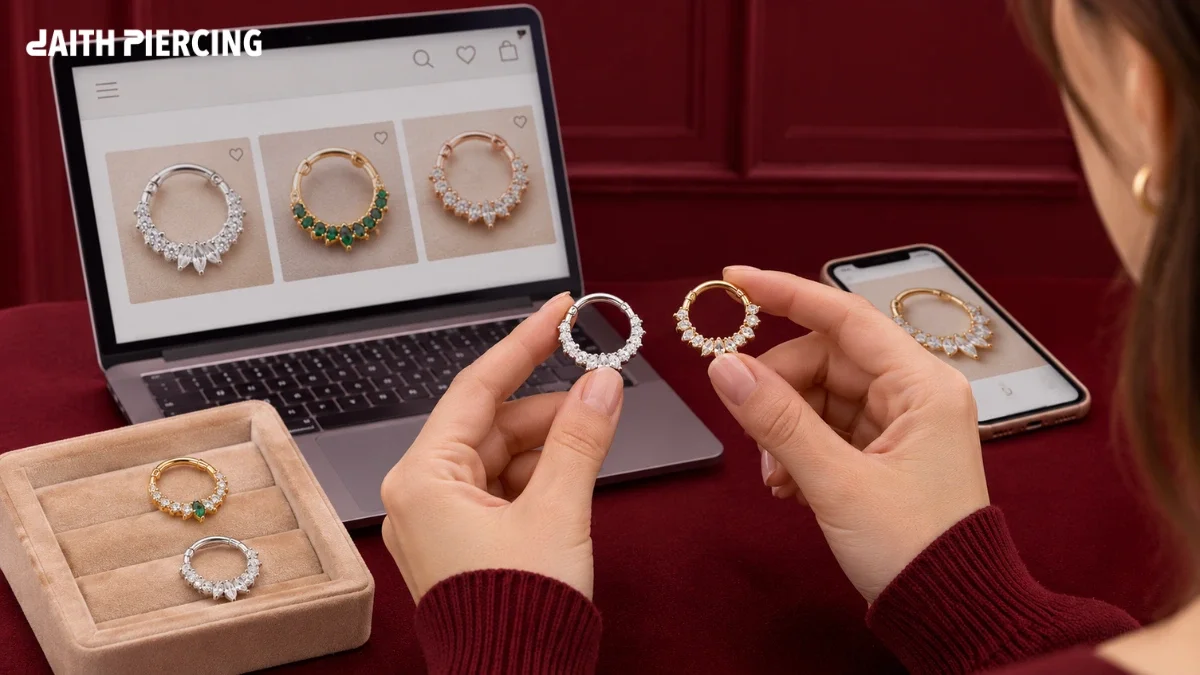
Compare daith clickers: Learning how to compare daith clickers before you buy is the single skill that saves you the most money in fine body jewelry, and it is the one almost nobody teaches properly. Most comparison guides rank products against each other. This one teaches you to compare products against your own life, which is the comparison that actually matters.
You know the moment I mean. Two browser tabs open, three more on your phone, every ring beautiful in its own square of light, and a quiet pressure behind your ribs that says: what if I choose wrong. I have been there more times than I will admit. The truth I learned after years of collecting is that the regret never comes from picking the second prettiest ring. It comes from picking a ring that was never built for the life you actually live.
Why comparing spec sheets fails you
Compare daith clickers: Here is the problem with every comparison table you will find online. It compares clicker A to clicker B on metal, gauge, diameter, and price. Useful numbers, wrong question. A clicker does not live on a spec sheet. It lives on your ear while you take phone calls against your shoulder, while you pull a sweater over your head, while you sleep on your side with your ear folded into a pillow for seven hours.
Two clickers can share identical specifications and behave completely differently in a real week. One has a seam that catches every loose hair. One has a hinge that digs when you wear over ear headphones. No spec sheet tells you that, because no spec sheet knows who you are.
So forget the table for a moment. I am going to give you a better instrument, and it fits on an index card.
The Friction Map: compare against your week, not against other rings
This is the framework I wish someone had handed me years ago, and I have never seen it anywhere else. It works like this. Before you compare a single product, you list the moments in your week where your jewelry meets resistance. I call them friction points, and they are personal to you, which is exactly why this method works where generic tables fail.
Your friction map probably includes some of these:
- The pillow, especially if you sleep on your pierced side
- Phone calls with the phone pressed to your ear
- Over ear or in ear headphones
- Pulling shirts, sweaters, and scarves over your head
- The gym, with sweat, hair ties, and towel pressure
- Long hair that falls forward and tangles
- Hugs, haircuts, and dentist chairs, yes, really
Now take the two or three clickers you are considering and score each one from one to five on every friction point on your map. Five means it disappears into that moment. One means it announces itself. A clicker that loses points at the pillow but wins everywhere else might be perfect for a back sleeper and a disaster for a side sleeper. Same ring. Different life.
Add the scores. The highest total is your ring. It is genuinely that simple, and it has never once pointed me to the wrong piece.
If you are unsure how to judge a hinge, a seam, or the ring memory during your scoring, our premium buyer’s guide to daith clickers gives you a ten second quality test you can run on any ring before it earns a place on your map.
The five things worth scoring on any clicker
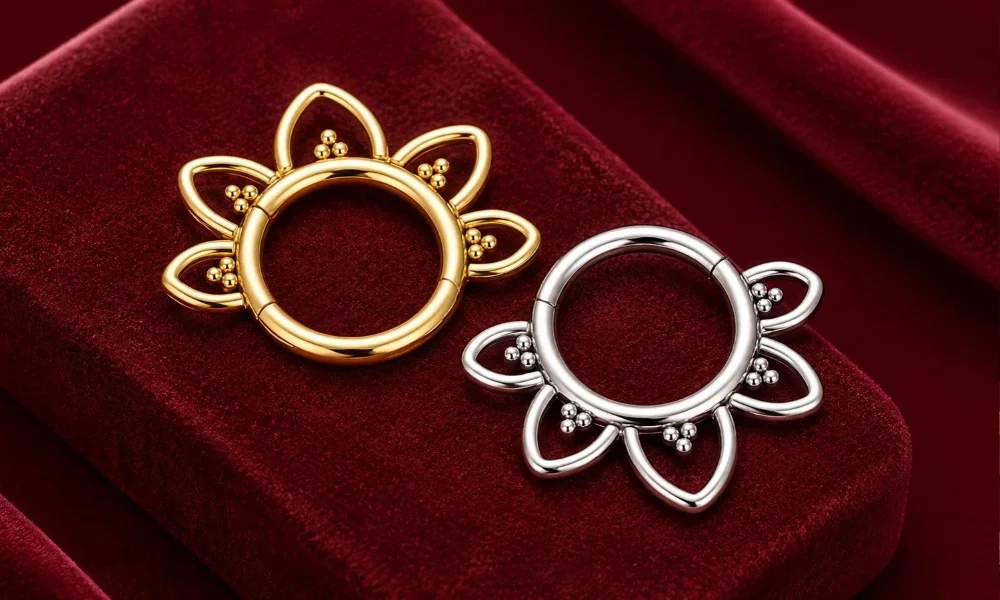
Beyond your personal friction points, five physical qualities deserve a score on every candidate. These are the dimensions where clickers actually differ from each other in daily wear.
Hinge quality. Open it with one thumb. Smooth and quiet means the engineering is there. Stiff, springy, or gritty means the ring will fight you every morning for as long as you own it.
Seam finish. Drag a fingernail across the joint. A fine seam whispers. A rough seam catches, and everything you love about a ring dies a little every time it snags your hair.
Weight. A quality clicker feels almost weightless. Heavy rings tug subtly at a healing channel and tire the ear over long days. Hold your candidates and notice which one your fingers forget they are holding. That one.
Diameter and gauge. These must match your anatomy and your piercing, full stop. A perfect ring in the wrong size is still the wrong ring. If you do not know your numbers yet, our guide on the questions to ask before you buy walks you through getting them from your piercer in one short visit.
Interior polish. The inside of the ring touches you all day. A cotton swab dragged along the interior will glide on a well finished ring and grab on a lazy one.
A worked example, so you can see it in action
Let me show you the method with two rings I will call the Everyday and the Showpiece.
The Everyday is plain 14k gold, a fine seam, a light hinge, no stones. The Showpiece is pavé set, slightly heavier, with a hinge that is good but not exceptional. On beauty alone, the Showpiece wins every time, and most comparison tables would crown it.
Now score them on my friction map. Pillow: Everyday five, Showpiece three, those stones press. Phone calls: Everyday five, Showpiece four. Sweater test: Everyday five, Showpiece two, the pavé grabs knit like a burr. Gym: five and two. Workday: five and four. Total: twenty five for the Everyday, fifteen for the Showpiece.
The Showpiece is not a bad ring. It is a bad daily ring. It belongs in a rotation, worn on evenings when the only friction point is candlelight. The map did not kill it. It found the home where it will be loved instead of resented.
That distinction, daily ring versus occasion ring, is the quiet decision hiding inside every clicker purchase, and the friction map makes it for you in about three minutes.
Comparing prices without fooling yourself
Once the map narrows your field to one or two rings, price comparison becomes honest math instead of marketing fog. Do not compare sticker prices. Compare cost per wear, which we unpack fully in our article on what makes daith clickers expensive. Divide the price by the number of days you will realistically wear the ring in the next two years. A $400 clicker worn daily costs about 55 cents a day. A $90 clicker worn twice and abandoned costs $45 per wear. The expensive ring was the cheap one.
There is also the failure cost that nobody prices in. A clasp that opens in your sleep, a seam that tears hair, a hinge that dies in four months. Cheap clickers collect small losses until they cost more than the fine ring would have.
The eighty percent rule for ending comparison paralysis
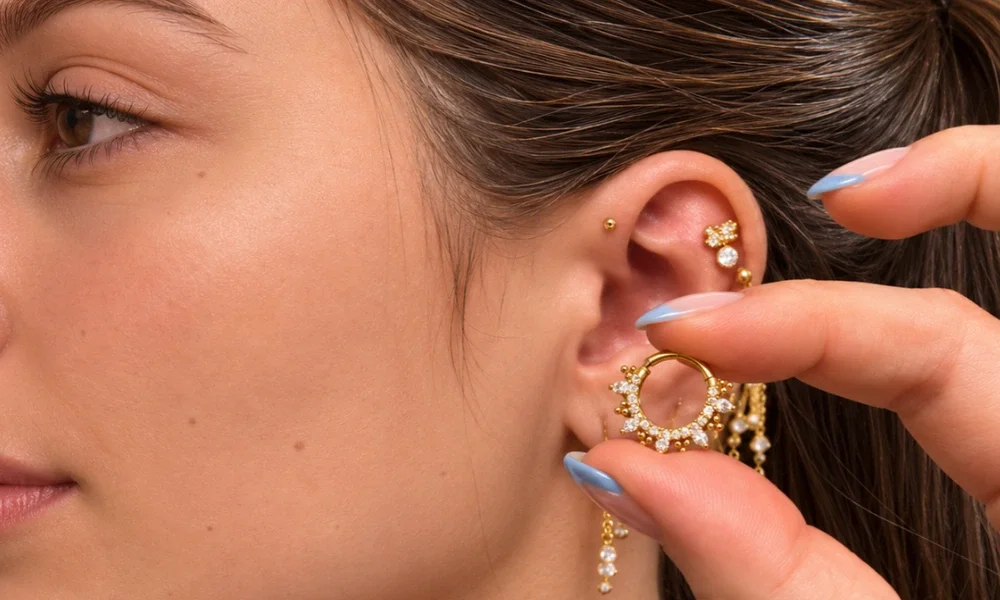
Here is my last gift, and it is a rule, not a suggestion. When one clicker scores clearly highest on your friction map and passes the physical checks, and you find yourself opening a fourth browser tab looking for something marginally better, stop. A ring you love at eighty percent certainty, worn for two happy years, beats a mythical perfect ring you never buy.
Collectors call this the eighty percent rule. Buyers who ignore it end up with six tabs open and no ring at all. I have been that person. The ear stays bare, the tabs stay open, and the ordinary Tuesdays pass without the small lift a good ring gives you.
The last thing I will tell you
Comparison, done the usual way, is a contest between products. Done this way, it is a conversation between a ring and your life. The right clicker is not the one that wins the spec sheet. It is the one that disappears into your Tuesday and shows up exactly when the light is good. Your friction map will find it faster than any ranking on the internet, because your map is the only one that knows you.
Frequently asked questions
How do I compare daith clickers with different materials?
Start by considering your skin sensitivity and material preferences. If you have sensitive skin, focus on implant-grade titanium and solid gold. Compare both options based on comfort, durability, and finishing quality. The overall design and engineering of the clicker can matter just as much as the material.
What matters more when comparing clickers, the hinge or the seam?
The hinge is more important because it keeps the clicker securely closed and prevents it from falling out. A rough seam can cause discomfort, but a poorly designed hinge can make the jewelry unsafe to wear. Always prioritize hinge quality, followed by seam finishing and overall design.
How many clickers should I compare before buying?
Comparing three daith clickers is usually enough to make a good decision. Looking at fewer than three options may limit your choices, while comparing more than five can make the process unnecessarily complicated. Focus on three options and evaluate their materials, comfort, hinge quality, and price.
Is it worth comparing a cheap clicker against a fine one?
Yes, comparing affordable and premium clickers helps you understand their long-term value. A cheaper clicker may cost less initially, but a high-quality option can offer better durability, comfort, and reliability over time. Consider the cost per wear rather than focusing only on the purchase price.
Where can I see daith clickers already compared with this method?
You can explore the editor’s roundup of the best daith clickers of 2027, which compares different options using the friction map method. Once you choose a suitable design, the guide to ordering daith clickers online can help you understand the buying process. You can also visit the complete daith jewelry guide for more information.